

Saved Bookmarks
| 1. |
A series LCR circuit is connected to an ac source having voltage v=v_(m) sin omega t. Derive the expression for the instantaneous current I and its phase relationship to the applied voltage. (i)Maximum and (ii) minimum. |
|
Answer» Solution :(a) (1) Equivalent impendance (Z) is LCR circuit: The effective resistance offered by a series LCR-circuit is called its impedance. It is DENOTED by Z. Suppose an inductance L, capacitance C and resistance R are connected in series to a source of alternating emf, `V=V_0` sin wt. Let, I be the instantaneous value of CURRENT in the series circuit. Then voltages across the three components are (i) `V_L=X_L I` It is ahead of current I in phase by `90^@`. (ii) `V_C=V_C I`. it lags BEHIND the current I in phase by `90^@`. (iii) `V_R=RI`. It is in phase with current I. 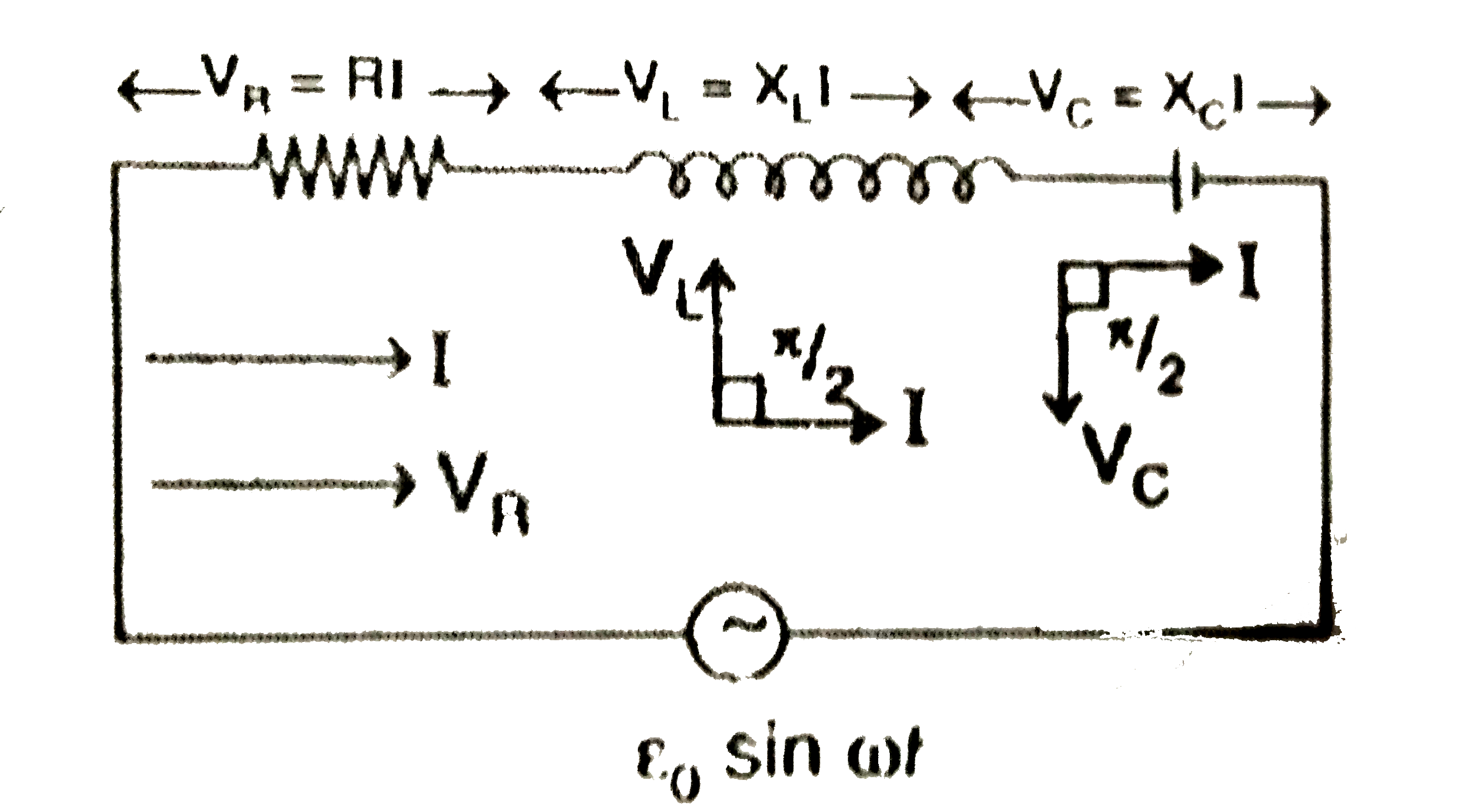 These voltages are shown in the phasor diagram given below : 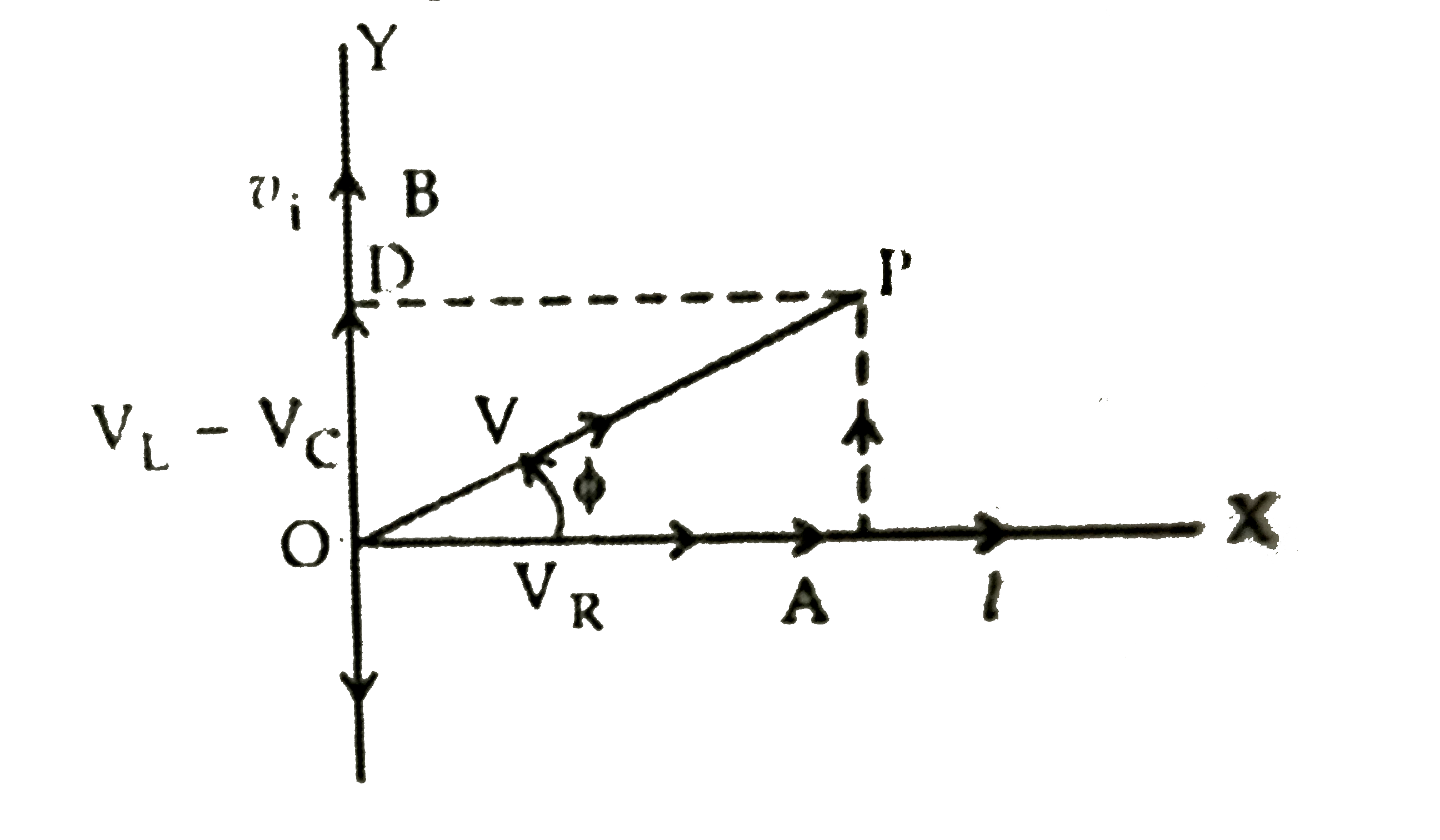 As ` V_L and L_C` are in opposite directions, their resultant is ` OD =V_L-V_C`, in the positive y-direction By paralllelogram law, the resultant voltage is ` V=OP` `=sqrt(OA^2+OD^2)=sqrt(V_(R)^(2)+(V_L-V_C)^2)` ` =sqrt(R^2I^2+(X_LI-X_CI)^2)=Isqrt(R^2+(X_L-X_C)^2)` ` therefore (V)/(I) =sqrt(R^2+(X_L-X_C)^2)`. Clear, `V//I` is the effective resistance of the series LCRcircuit and is called its impedance (Z). ` therefore Z=sqrt(R^2+(X_L-X_C)^2)=sqrt(R^2+(Omega L-(1)/(OmegaC))^2)[{:(because X_L=OmegaL),(X_C=1//OmegaC):}]` (2) When Z=R, then `X_1=X_C` ` therefore Omega L=(1)/(OmegaC) rArr Omega^2LC =1 rArr Omega =(1)/(sqrt(LC))` (3) , From phasor diagram, it follows that in LCR series circuit, V leads I `(X_Lgt L_C)` by phase angle `phi` then `tan phi= (AP)/(OA) =(V_L-V_C)/(V_R)` `tan phi=(IX_L-IX_C)/(IR)rArr tan phi =(X_L-X_C)/(R)` `tan phi =("Reactive Impedance")/("Resistance")` `thereforephi =tan^-1 [("Reactive Impedance ")/("Resistance")]` `because " Impedance " Z=sqrt(R^2+(X_L-X_C)^2)` For resonance, `X_L=X_C therefore Z=sqrt(R^2)rArr Z=R` Hence, for the CONDITION of resonance, impedance is equal to resistance. Power factor : Power factor is defined as the ratio of true power to apparent power. it is denoted by `cos phi`. `therefore "Power factor"cos phi= (R)/(sqrt(R^2+(X_L-X_C)^2))` (i) Power factor is maximum when the circuit contains only R. (ii) Power factor is minimum for purely inductive or capacitive circuit. |
|