

Saved Bookmarks
| 1. |
(a) Show that the normal component of electrostatic field has a discontinuity from one side of a charged surface to another given by: (vecE_(2)-vecE_(1)).hatn =(sigma)/(epsilon_(0)) where hatn is a unit vector normal to the surface of a point and sigma is the surface charge density at that point. (The direction of hatn is from side 1 to side 2). Hence, show that just outside a conductor, the electric field is (sigma hatn)/(epsilon_(0)). (b) Show that the tangential component of electrostatic field is continuous from one side of a charged surface to another. |
|
Answer» Solution :(a) The electric field due to a charged surface having surface charge density `sigma` is given by: `vecE=(sigma)/(2epsilon_(0)) hatn` Let us consider a charged surface carrying surface charge density `sigma` as shown in thefigure.  The electric field intensity at the side-2 is given by: `vecE_(2)=(sigma)/(2epsilon_(0))hatn` The electric field intensity at side-1 is given by: `vecE_(1)=(sigma)/(2epsilon_(0))hatn` There will be discontinuity in the electric field due the charged surface as the directions of the `vecE_(1) and vecE_(2)` will be opposite. Thus, the discontinuity in the electric field is given by, `vecE_(2)-vecE_(1)=(sigma)/(2epsilon_(0))hatn-(-(sigma)/(2epsilon_(0)))hatn=(sigma)/(epsilon_(0)) hatn` `rArr (vecE_(2)-vecE_(1))hatn=((sigma)/(epsilon_(0))hatn)hatn=(sigma)/(epsilon_(0))` Since the difference of the electric field intensities on the two sides of the surface is non-zero, the two electric fields are unequal. So, there is a discontinuity. In case of the surface is conducting the electric field will be zero at its one side because that lies inside the conductor.s volume. Thus, on substituting `vecE_(1)=0` `vecE_(2)-vecE_(1)=(sigma)/(epsilon_(0)) hatn` `vecE_(2)=(sigma)/(epsilon_(0))hatn` (b) 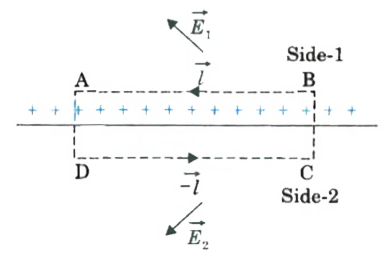 Let `vecE_(1) and vecE_(2)` be the electric fields on both sides of the charged surface. Let us assume a rectangular loop of negligible width and LENGTH `l` as shown in above figure. Side AB of the loop is on side-1 of the charged surface and the side CD is on the side-2 of the charged surface. As we KNOW the net work done in moving a charged particle in a closed loop is zero inside electrostatic field. Thus, work done in moving a unit charged particle along ABCD must be zero. `vecE_(1)*vecl+vecE_(2). (-vecl)=0` [The width of the loop AD and BC is neglected] Thus, `E_(1)l cos theta_(1)-E_(2)l cos theta_(2)=0` `rArr E_(1)cos theta_(1)=E_(2)cos theta_(2)` Here, `theta_(1) and theta_(2)` are the angles made by `vecE_(1)` and `vecE_(2)` with the charged surface. `E_(1) cos theta_(1) and E_(2)cos theta_(2)` are the TANGENTIAL components of the electric field on two sides of the surface and we have proved them to be equal. Hence, the tangential component of electric field (if it exists) will be same on both sides. |
|