

Saved Bookmarks
| 1. |
A small ball of conducting material having a charge +q and mass m is thrown upward at and angle theta to horizontal surface with an initial speed nu_(0) as shown in the figure. There exists an uniform electric field E downward along with the gravitational field g . Calculate the range maximum height and time of flight in the motion of this charged ball. Neglect the effect of air and treat the ball as a point mass . |
|
Answer» Solution :If the conductor has no net CHARGE then its motion is the same as usual projectile motion of a mass m . Here in this problem in additionto downward gravitational force the charge also will experience a downward uniform electronstatic force. The acceleration of the charged ball due to gravity =-g `HATJ` The acceleration of the chargedball due to uniform ELECTRIC field = `-(qE)/(m)hatj` The total acceleration of charged ball in downward direction `vec=-(g+(qE)/(m))hati` It is important here to note that the acceleration depends on the mass of the OBJECT . Galileo conclusion that all objects fall at the same rate towards the Earth is true only in a unifrorm gravitational field . When a uniform electric field is included the acceleration of a charged object depends on both mass and charge . But still the acceleration a = `(g+(qE)/(m))` is constant through the motion. Hence we use kinematic equations to calculate the range maximum height and time of flight. In fact we can simply replace g by `g+(qE)/(m)` in the usual expressions of range maximum height and time of flight of a projectile . 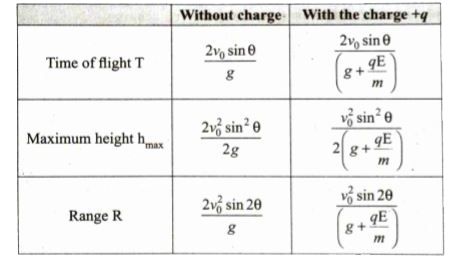 Note that the time of flight maximum height range are all inverselyproprotional to the acceleration of object . Since `(g+(qE)/(m)) gt g` y for charge +q the quantities T, `h_("max")` and R will decrease when compared to the motion of an object of mass m and zero net charged. Suppose the charges is then `(g-(qE)/(m))lt g ` and the quantities T `h_("max")` and R will increase . Interestingly the trajectory is still parabolic as shown in the FIGURE . 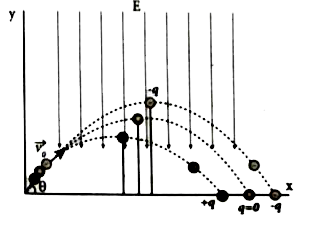
|
|