

Saved Bookmarks
| 1. |
A small bead of mass m can moves on a smooth circular wire (radiusR) under the action of a force F=(km)/r^(2) directed (r=position of bead from P&K=constant) towards a point P with in the circle at a distance R/2 from the centre what should be the minimum velocity of bead at the point of the wire nearest the centre of force (P) so that bead will complete the circle |
|
Answer» `sqrt((3k)/R` 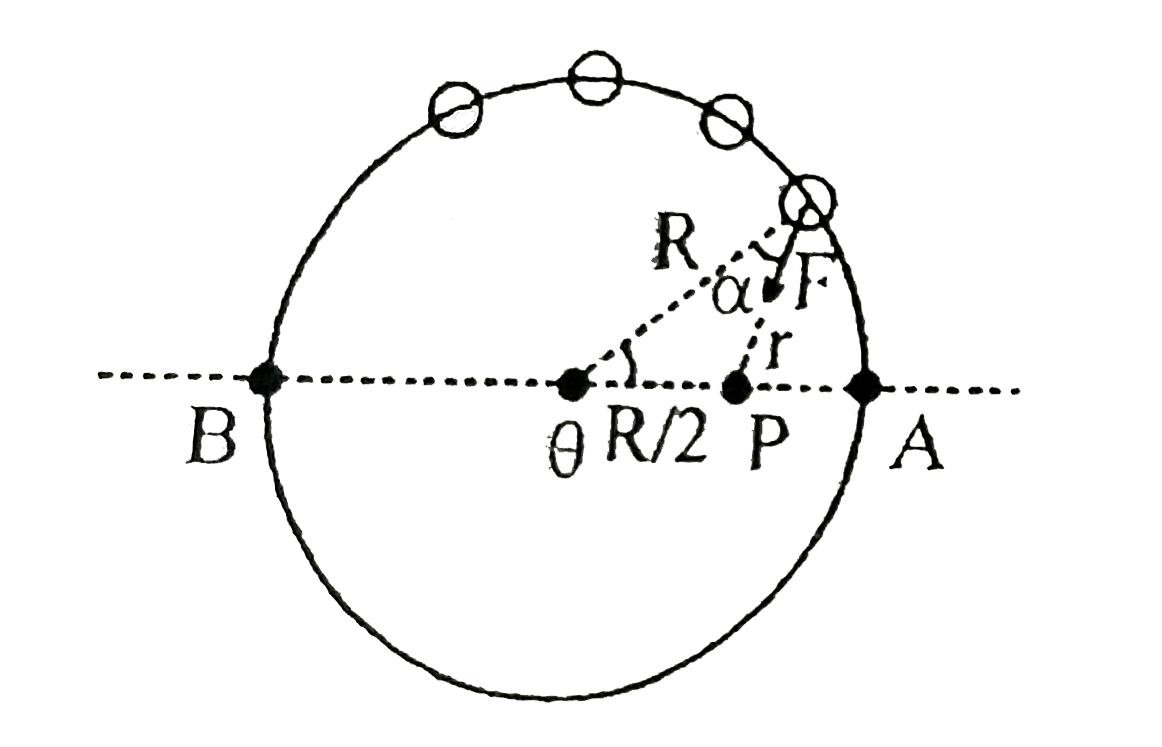 value of A at any angular position 'theta' is given by `f=(km)/r^(2)` here is given by `r=sqrt((Rcostheta-R//2)^(2)+(Rsintheta)^(2))=sqrt(R^(2)+R^(2)//4-R^(2)costheta)=R/2sqrt(5-4costheta)` `Also (2sinalpha)/R=sin 0/r i.e sinalpha =sintheta/sqrt(5-4costheta)` for SMALL angular displacement 'dtheta' work done by this force dw =-frd0cos(9theta-alpha)=-fR sin alpha dtheta `(4kmR)/(R^(2)(5-4costheta)) sintheta/sqrt(5-4costheta)dtheta` work done in moving BEAD from ATOB `Deltaw=-(4km)/R underset(theta)OVERSET(pi)(int) (sin theta d theta)/(5-4costheta)^(3//2)=-(km)/R underset(theta)overset(pi)(int)(4sin theta d theta)/(5-4costheta)^(3//2)` `=(km)/R underset(theta) overset(9)(int) (dt)/t^(3//2)=-(km)/R|t^(-1//2)/-(1//2)|_(1)^(9)` `=+(2km)/R(1/3-1)=-4/3(km)/R` :.Energy provided at point A most be equal to this work done ` :. 1/2mv_(m)^(2)=4/3(km)/R Rightarrow v_(MIN)= sqrt((8k)/(3R))` |
|