

Saved Bookmarks
| 1. |
A small bulb is placed at the bottom of a tank containing water to a depth of 80 cm. What is the area of the surface of water through which light from the bulb can emerge out? (Refractive index of water is 1.33. (Consider the bulb to be a point source) |
Answer» Solution :As SHOWN in Fig. 9.03 the LIGHT RAYS starting from a POINT object O (bulb in present case) situated at a depth h from surface of water can spread at the surface of a cone of semi-vertex angle ic equal to the critical angle of water.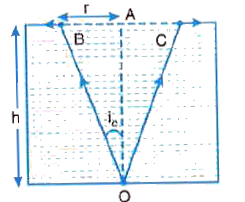 Thus, AB = AC = r= h `tan i_(c)`, where h= 80 cm = 0.8 m But by defintion `sin i_(c ) =1/n =1/1.33 = 0.75` `therefore r = h tan i_( c) =(h sin i_( c))/sqrt(1-sin^(2)i_( c))= (0.8 xx 0.75)/sqrt(1-(0.75)^(2)) = 0.91 m` `therefore` Area of water surface through which light can emerge out: ` A =pir^(2) = 3.14 xx (0.91)^(2) = 2.6 m^(2)` |
|