

Saved Bookmarks
| 1. |
A spherical conducting shell of inner radius r_(1) and outer radius r_(2) has a charge Q. ls the electric field inside a cavity (with no charge) zero, even if the shell is not spherical, but has any irregular shape ? Explain. |
|
Answer» SOLUTION :Charge placed at the centre of a shell is q. Hence, a charge of magnitude - q will be induced to the inner surface of the shell and + q charge induced on the outer surface of the shell. `:. ` Surface charge density at the inner surface of the shell is , `sigma=(q)/(A)=(-q)/(4pir_(1)^(2))` Surface charge density at the outer surface of the shell is `sigma_(0)=(q)/(A)=((+q)(+Q))/(4pir_(2)^(2))` Where `r_(1)` and `r_(2)` are radius of inner and outer of shell and Q is the magnitude of charge placed on the outer surface of the shell 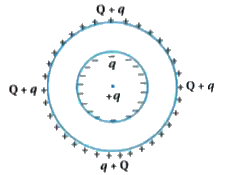 (B) YES The electric field intensity inside a cavity is zero, even if the shell is not spherical and has any irregular shape. Take a closed LOOP such that a part of it is inside the cavity along a field line while the rest is inside the conductor. Net work done by the field in CARRYING a test charge over a closed loop is zeru because the field inside the conductor is zero. Hence, electric field is zero whatever is the shape. |
|