

Saved Bookmarks
| 1. |
A spherical conducting shell of inner radius r_(1) and outer radius r_(2) has a charge Q: (a) A charge q is placed at the centre of the shell. What is the surface charge density on the inner and outer surfaces of the shell? (b) Is the electric field inside a cavity (with no charge) zero even if the shell is not spherical, but has any irregular shape? Explain. |
Answer» Solution :(a) Charge placed at the centre is Q so INDUCED charge oninner surface of metallic sphere must be equal and opposite so charge -q must appear on inner surface of sphere. Net charge on spherical conductor cannot change: hence charge on OUTER surface must be `Q+q`. 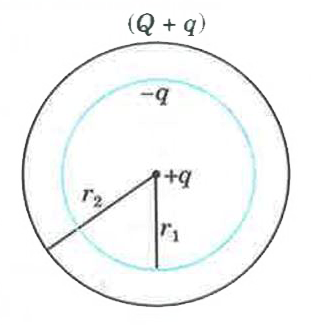 Surface charge density on inner surface of the spherical shell will be `sigma_(1)= -(q)/(4PI r_(1)^(2))` Surface charge density on outer surface of the spherical shell will be `sigma_(2)=(Q+q)/(4pi r_(2)^(2))` (b) Yes, the electric field inside a cavity (with no charge) is zero even if the shell is not spherical, but has any irregular shape because inside the volume of a conductor, the electric field is zero and if we make a cavity inside its volume even then electric field remains zero. This phenomenon is known as ELECTROSTATIC shielding. |
|