

Saved Bookmarks
| 1. |
A thin circular ring of radius r is charged uniformly so that its linear charge density becomes lambda . Derive an expression for the electric field at a point P at a distance x from it along the axis of the ring. Hence, prove that at large distances (r gtgt r), the ring behaves as a point charge. |
|
Answer» SOLUTION :Let a thin circular ring of radius . is charged unifornmly having a linear charge density `lambda`.. Let Pbe a point on the axis of the ring at a distance .x. from its centre. Consider an element of length Al around a point A of the ring carrying a charge `Deltaq = lambdaDeltaI` Electric field at point P due to this charge element is `|DeltavecE| =(1)/(4piin_(0)).(Deltaq)/((AP)^(2))=(1)/(4piin_(0)) .(lambda DeltaI)/((x^(2)+x^(2))` 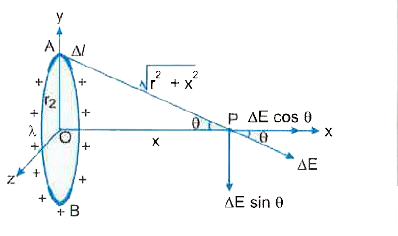 The electric field is directed along AP and thus subtends an angle 0 with the axis of the ring and can be resolved into TWO components (i) `DeltaE` cos `theta`along the axis, and (ii) `DeltaE` sin `theta`normal to the axis of ring. It is clear from symmetry that normal components `DeltaE` sin `theta`. due to mutually OPPOSITE charge elements (say A and B) nullify each other, but their axial components `.DeltaE cos theta` are added up. `:.` Net electric field at point P due to whole charged ring will be `E =sumDeltaE cos theta= sum (1)/(4piin_(0)).(lambdaDeltal)/((r^(2)+x^(2))).(x)/(sqrt(r^(2)+x^(2)))` `=(lambdax)/(4piin_(0)(r^(2)+x^(2))^(3//2))sum DeltaI= (lambda.x)/(4piin_(0)(r^(2)+x^(2))^(3//2)).2pir` `= (lambdarx )/(2in_(0)(r^(2)+x^(2))^(3//2))` The field `vecE` is directed along the axis OP of the charged ring If x `gtgt` r, then the above relation may be written as `E = (lambdarx)/(2in_(0)(x^(2))^(3//2))=(lambdar)/(2in_(0)x^(2))` As total charge on the ring q =` lambda.2pir ` so `lambdar= (q)/(2pi)` and HENCE E = `(q)/(4pi in_(0)x^(2))` The above relation shows that electric field is same as that due to a point charge q situated at the centre of ring IE., the charged ring is now behaving as a point charge. |
|