

Saved Bookmarks
| 1. |
A thin insulating wire is stretched along the diameter of an insulated circular hoop of radius E. A small bead of mass m and charge –q is threaded onto the wire. Two small identical charge= are tied to the hoop at points opposite to each other, so that the diameter passing throughtheL-is perpendicular to the thread (see figure). The bead is released at a point which is a distance-, from the centre of the hoop. Assume that x_0 ltlt R. a. What is the resultant acting on the charged bead? b. Describe (qualitatively) the motion of the bead after it is released. c. Use the assumption that x//Rltlt1 to obtain an approximate equation of motinand find the dislacemet ad velocity of the bead as functuions of time. d. When will the velocity of the bead will become zero for the first time? |
|
Answer» `=(2kQ.q)/(sqrt(R^2+x_0^2)^2).x_0/sqrt((R^2+x_0^2)("Here", k=1/(4piepsilon_0)` `=(2kQqx_0)/((R^2+x_0^2)^(3/2))` 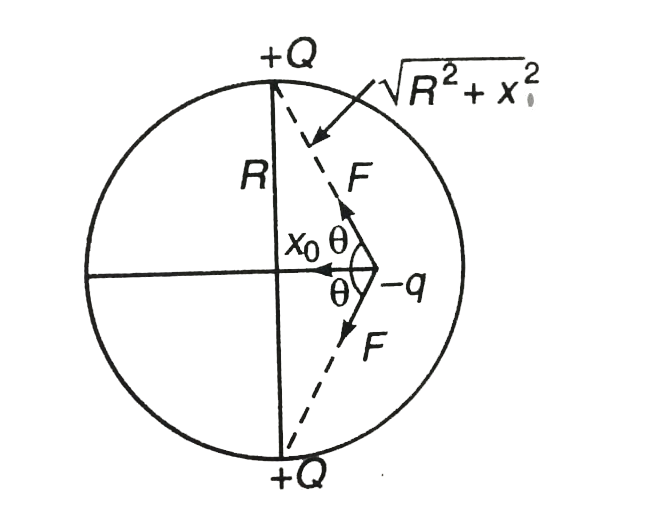 We can generalised the FORCE by putting `x_0=x` we have `F=-(2kQqx)/((R^2+x^2)^(3/2))` Motion of bead will be periodic between `x=+-x_0` c. for x/Rltlt1, R^2+x^2=R^2` `or F=-((2kQq)/R^3)xor a=F/m=-((2kQq)/(mR^3))x` since `aprop-x` motion will be simple ha.rmonic in nature. Comparing with `a=-omea^2x, omega=sqrt((2kQq)/(mR^3))` `x=x_0cos OMEGAT` (as the particle starts form extreme position) `v=(dx)/(dt)=-omegax_0sinomegat` d. Velociyt wil become ZERO at `t=T/2=pi/omega` 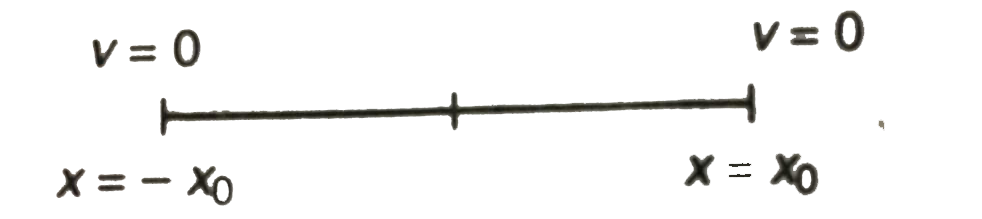 or `t=pisqrt((mR^3)/(2kQq))` |
|