

Saved Bookmarks
| 1. |
A triangle is made from thin insulating rods of different lengths, and the rods are uniformly charged, i.e. the linear charge density on each rod is uniform and the same for all three rods. Find a particular point in the plane of the triangle at which the electric field strength is zero |
|
Answer» Solution :We are going to prove that the electric field strength is zero at the SOCALLED incentre, the CENTRE of the triangle's inscribed circle (which has radius r in the figure) Let us consider a small length of rod at position P on one of the sides of the triangle, let it subtend an angle `Delta varphi` at the incentre (see figure). Its distance from the incentre is `r//cos varphi`. Its small length `Deltax` can be found by noting that P is a distance `x=r tan varphi` along the rod from the fixed point Q and so `Deltax=(r Delta varphi)//(cos^(2) varphi)`. Consequently the charge it carries is `Deltaq=(lambda r Delta varphi)/(cos^(2) varphi)` where `lambda` is the linear charge density on the RODS. The magnitude of the elementary contribution of this small piece to the electric field at the incentre is `DeltaE=1/(4pi epsi_(0)) (Delta q cos^(2) varphi)/r^(2)=1/(4pi epsi_(0)) (lambda r Delta varphi)/r^(2)` It can be seen from this result that the same electric field (in both magnitude and DIRECTION) would be produced by an arc of the inscribed circle that subtends `Delta varphi` at the circle's centre and carries the same linear charge density `lambda` as the rod. Summing up the CONTRIBUTIONS of the small arc pieces correspondingto all threesides of the triangle, we will, because of the circular symmetry, obatin zero net field. It follows that the electric field strength produced by the charges sides of the triangle is also zero at the incentre. 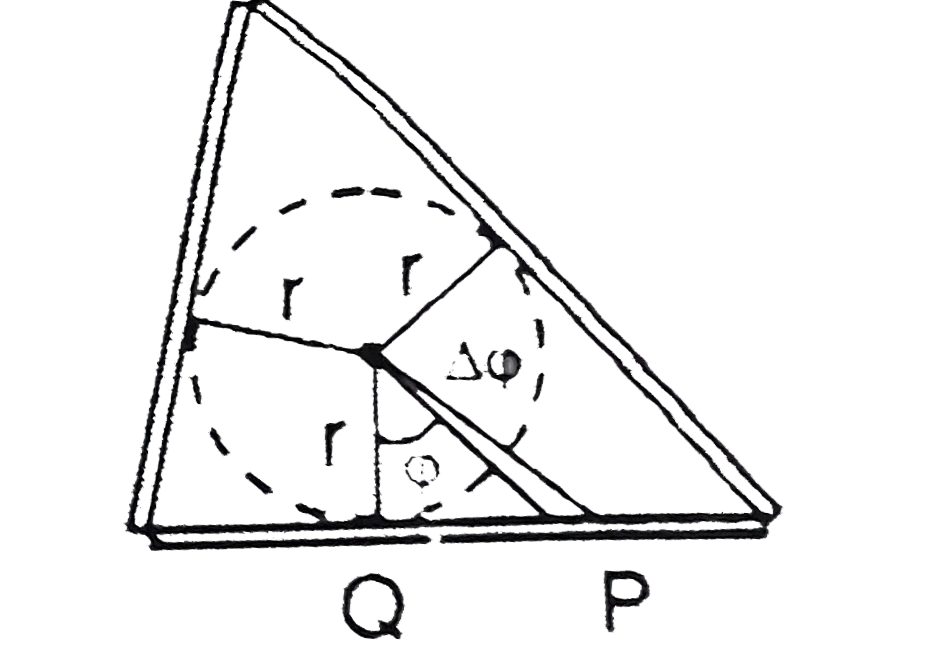
|
|