

Saved Bookmarks
| 1. |
(a) Two thin lenses are placed coaxially in contact. Obtain the expression for the facal lengths of the lenses. (b) A converging of refractive index 1.5 has power of 10 D. When it is completely immersed . In a liquid , it behaves as a diverging lens of focal length 50 cm. Find the refractive index of the liquid. |
|
Answer» Solution :(a) Consider two thin lenes A and B of focal lengths `f_1 and f_2` placed in contact. Let a point object be placed at O, beyond the focus of first lens. A Lens A forms a real image at `I_1`. This imagge serves as VIRTUAL object for second lens B and the final real image is formed at I. For image `I_1` formed by first lens, we have `1/(v_1)-1/u=1/(f_1) ""...(1)` and for the image I formed by the second lens , we have `1/v-1/v_1=1/(f_2)""...(ii)` Adding (i) and (ii) ,we have `1/v-1/u=(1)/f_1+1/(f_2)""...(iii)` If the two lens system is considered as EQUIVALENT to a single lens of focallength f , then `1/v-1/u=1/f""...(iv)` Comparing (iii) and (iv), we find that `1/f=1/f_1+1/f_2` (b) Here refractive index of lens n = 1.5 , its power in air = P = +10 D, hence its focal LENGTH in air `f=1/p=1/10=10 cm` . when immersed in liquid of refracting index, `n_l` the lens BEHAVES as a diverging lens length 50 cm , i.e. `f_e = - 50 cm`. As per lens formula `1/f=(n-1)(1/R_(1) - 1/R_(2))`, we have `1/10 = (1.5 -1) (1/R_1-1/R_2)""` ...(1) , and `1/(-50)=((1.5)/n_l-1)(1/R_(1)-1/R_2)""` ...(2) Dividing (i) by (ii) , we get `-5=(0.5)/(((1.5)/n_l-1))` `implies ((1.5)/n_l-1)=-(0.5)/5=-0.1` `implies (1.5)/n_l=1-0.1=0.9` `implies n_(1)=(1.5)/(0.9)=1.67` 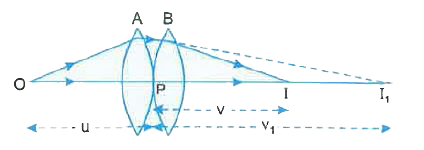
|
|