

Saved Bookmarks
| 1. |
A uniform magnetic field of 1.5 T exists in a cylindrical region of radius 10.0 cm, its direction parallel to the axis along east to west. A wire carrying current of 7.0 A in the north to south direction passes through this region. What is the magnitude and direction of the force on the wire if, (a) the wire intersects the axis, (b) the wire in the N - S to northest - northwest direction. (c) the wire in the N-S direction is lowered from hte axis by a distance of 6.0 cm ? |
|
Answer» Solution :(a) It is given that `B = 1.5 T` is present in a cylindircal region of radius r = 10.0 cm along east to west. It has been shown in fig. by sing `ox` , assuming east to west into the plane of paper. The wire carrying CURRENT I = 7.0 A is placed PERPENDICULAR to the magnetic axis along north (N) to south (S) direction. Then , `F = B I l SIN theta = 1.5 xx 7 xx (20 xx 10^(-2)) sin 90^@` `= 2.1 N ][ :. l = "diameter"= 20 cm = 20 xx 10^(-2) m]` Since `vecB` acts along east to west and `vecl` is in north to south, the force `vecF` is in direction `I vecI xx vecB`, ie., vertically downwards direction. 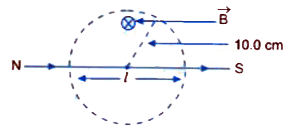 (b) As shown in fig, now the length of the wire inside the magnetic field is `2(10/(sin theta))` cm. The magnitude of the force is `F = B I l sin theta = B I [(2((10)/(sin theta)) xx 10^(-2)] sin theta` `= 1.5 xx 7.0 xx 20 xx 10^(-2) = 2.1 N` The force acts in vertically downward direction. 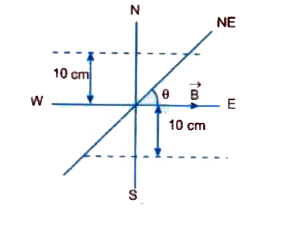 (C) When the wire is lowered from the axis by a distance of 6 cm, as shown in fig., the length of the wire inside the magnetic field is `l = 2 xx sqrt((10)^(2) - (6)^(2)) cm = 2 xx 8 cm` `= 2 xx 8 xx 10^(-) m = 0.16 m` `:. ` The magnitude ofthe magnetic force on the wire is `F = B I l sin 90^@` `= 1.5 xx 7.0 xx 0.16 = 1.68 N` 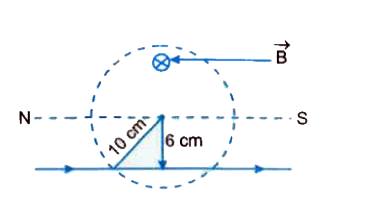
|
|