

Saved Bookmarks
| 1. |
A uniform non-conducting rod of mass m and length l has linear charge densities+lambda and -lambda on its two halves, as shown in the figure. It is hinged at its midpoint, so that it can rotate freely about the mid-point in a uniform electric field E parallel to X-axis. The rod is rotated by a small angle theta(lt 4^(@)) and released. Calculate the time period of small oscillations of the rod. |
|
Answer» Solution :The torque DUE to the electrostatic force on a length dx of the rod at point A (about point O), `d tau_(1)=x(dF_(1))sin theta=x lambda dx E sin theta` Similarly, torque due to the electrostaticforce on a length dx of the rod at point B (about point O), `d tau_(2)=x(dF_(2)) sin theta=x lambda dx E sin theta` 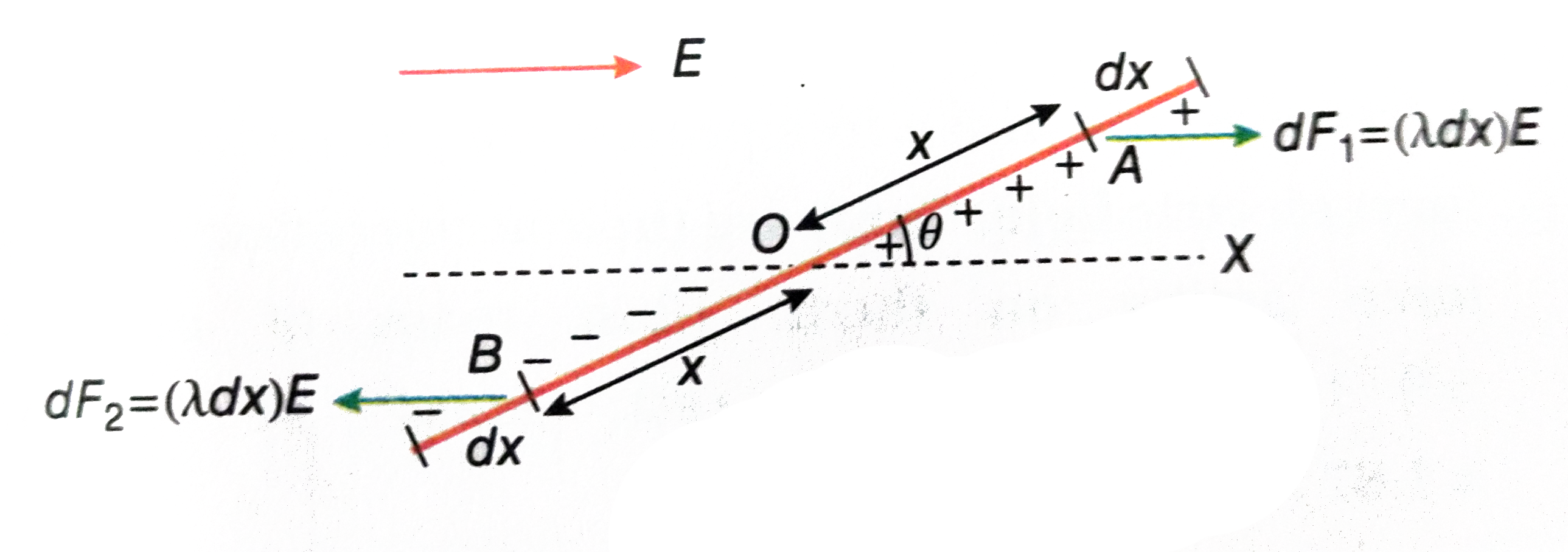 `therefore` Net torqueon the rod, `tau=int_(0)^((l)/(2))d tau_(1)+int_(0)^((l)/(2))d tau_(2)` `=2 int_(0)^((l)/(2))E lambda dx x sin theta""[ d tau_(1)=d tau_(2)]` `=2E lambda theta =int_(0)^((l)/(2))x dx""[ because theta" is small," sin theta~~theta]` `therefore tau=(E lambda l^(2))/(4)theta""`...(1) In this case moment of intertia of rod, `I=(ml^(2))/(12)` `therefore tau =I ALPHA =(ml^(2))/(12)alpha""`...(2) Fromequations (1) and (2) we get, ` (ml^(2))/(12)alpha=(E lambda l^(2)theta)/(4) or, alpha=(3E lambda )/(m) theta` `therefore ` Time period of oscillationsof the rod, `T=2PI sqrt((theta)/(alpha))=2pi sqrt((m)/(3E lambda))` |
|