

Saved Bookmarks
| 1. |
A uniform rod of mass m and length l is hinged about one of its end. The hinge is smooth and rod lies on a smooth horizontal surface as shown in Fig. A particle of mass m is coming towards the rod at speed v_(0) perpendicular to the length of rod. (a) Find angular velocity of the rod just after impact. (b) Also find impulse due to hinge on rod during collision. |
|
Answer» Solution :(a) (1) When the particle will hit the rod, the hinge will restrict the motion of the end of the rod. We can IMAGINE the rod starting to rotate about hinge and particle continuing to move on same line of motion. The impulse that particle will experience by rod is along the line of motion. (2) We will consider rod and particle as our system. This system will experience external impulse due to hinge. So, the momentum of the system cannot be conserved. But the angular momentum of the system about hinge will remain conserved as TORQUE due to impulse at hinge is zero. Calculation: By conserving angular momentum about hinge `mv_(0)x=mvx+(ml^(2)omega)/3` Here v is the speed of particle after the collision and `omega` is the angular velocity of rod after the collision as shown in Fig. We can also write Newton.s law of collision remembering that it is the velocity of constant points that is required. Thus, `(omegax-v)/(0-v_(0))=-e` Solving Eq. and,we get `omega=(3v_(0)x(1+e))/((l^(2)+3x^(2)))` 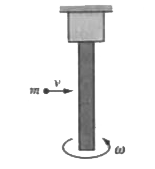 (b) (1) Coefficient of restitution is e and perpendicular distance of line of motion from hings is x. Consider e = 1/3, `v_(0)` = 3 m/s, l = 1 m, m = 2 KG and x = 1/3 m. (2) Now to find impulse `J_(1)`, due to the hinge, we will consider rod and particle as our system and write impulse and momentum equations. Calculation: We should remember that impulse between rod and particle during the collision need not be considered since it will be in internal impulse, thus we can write `vecJ_(1)=(vecP_("rod "f)+vecP_("particle "f))-(vecP_("rod "i)+vecP_("particle "i))` `vecP_("particle "i)=6 Nm" "vecP_("rod "i)=0` For `vecP_("particle".f)` we need to find speed of particle from part (a). `omega=(3xx3xx(1//3)(1+1//3))/([1^(2)+3(1//3)^(2)])` Now solving for v by putting value of `omega`, we get `(3xx(1//3)-v)/(0-(3))=-1/3m//s` Solving for v = 0, we get `vecP_("particle".f)=0`. For `vecP_("rod".f)` we need velocity of center of mass of rod as `vecP_("rod".f)=MV_("com")`. Thus, `V_("com")=omegaxxr_(c)=omegaxxl/2=3/2m//s` and `P_("rod "f)=2xx3/2=3kgm//s` Hence, `J_(1)=(3+0)-(0+6)=-3kgm//s` |
|