

Saved Bookmarks
| 1. |
(a) Using the necessary ray diagram, derive the mirror formula for a concave mirror. (b) In the magnified image of a measuring scale (with equidistant markings) lying along the principal axis of a concave mirror, the markings are not equidistant. Explain. |
|
Answer» Let us consider RIGHT angled triangles A.B.F and MPF, which are similar triangles. Therefore, `(B.A.)/(PM)=(B.F)/(FP)` But as PM= AB, hence, we have `(B.A.)/(BA)=(B.F)/(FP)` ....(i) Again triangles APB and A.PB. are also similar triangles and we have `(B.A.)/(BA)=(B.P)/(BP)` 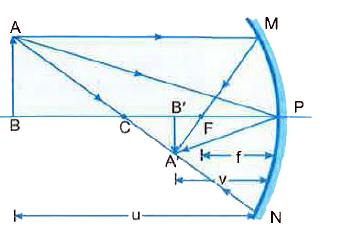 Comparing (i) and (ii), we get `(B.P)/(BP)=(B.F)/(FP)=(B.P-FP)/(FP)` As per sign convention followed: BP = -u, B.P =-v, and FP =-f Therefore, we get `((-v))/((-u))=((-v)-(-f))/((-f))rArrv/u=(v-f)/f` `rArrvf=uv-uf` or `uf+vf=uv` DIVIDING throughout by uvf, we get `1/v+1/u=1/f`, which is the requisite mirror formula. (b) Magnification of a mirror is given as: `m=-v/u=f/(f-u)` As different markings of a measuring scale lying along the principal axis of a concave mirror are at different positions (i.e., u is different for them), we get magnified images of these marks but magnification differs from one mark to another. As a result, the markings in image are not equidistant. |
|