

Saved Bookmarks
| 1. |
A very long uniformly charged thin wirewhose one end is at point (0,a) extends along positive y-axis . The charge per unit length of wire is lamda . The electric field at origin is |
|
Answer» `(lamda)/(4piepsi_0a)(-hatj)` 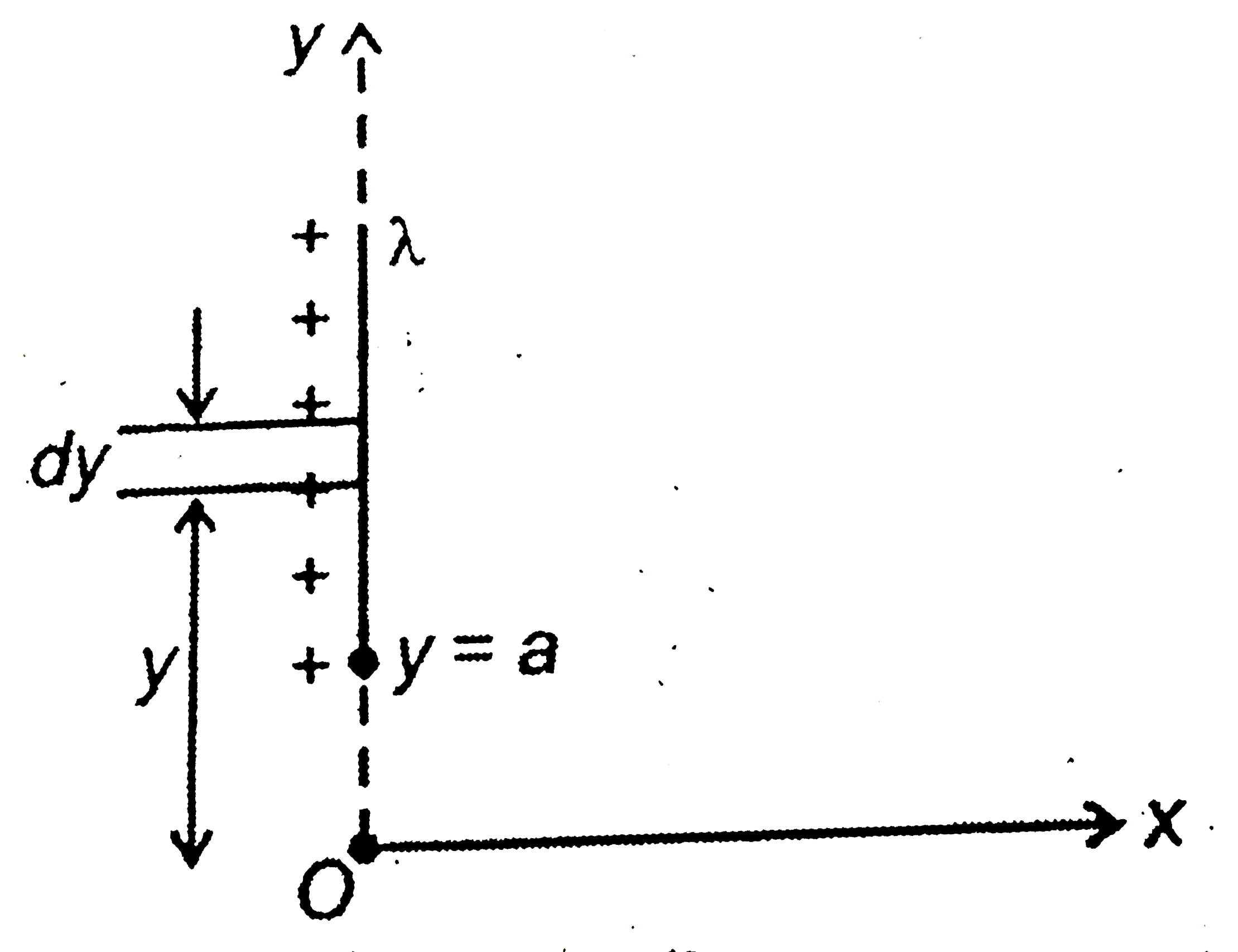 Consider on INFINITESIMALLY small element of length dy at a distance y from origin O. The CHARGE on this section is `dq=lamdady` Now, `dvecE_0 = (1)/(4piepsi_0).(dq)/(y^2) (-hatj)` `vecE_0 = (lamda)/(4piepsi_0) underset(a) OVERSET(00)INT (dy)/(y^2)(-hatj)= (-lamdahatj)/(4piepsi_0)[(1)/(-y)]_a^(oo)` `=(-lamdahatj)/(4piepsi_0) [ - (1)/(oo)- (-1/a)]` `VECE=(lamda)/(4piepsi_0a)(-hatj)` |
|