

Saved Bookmarks
| 1. |
(a) What is linearly polarized light ? Describe briefly using a diagram how sunlight is polarised. (b) Unpolarised light is incident on a polaroid. How would the intensity of transmitted light change when the polaroid is rotated? |
|
Answer» Solution :(a) Natural light is UNPOLARISED i.e., the electric vector takes all possible directions in the transverse plane, rapidly and randomly, during a measurement. A polarizer transmits only one component. This resulting light is called linear or plane polarized. The incident sunlight isunpolarised. The dot and double arrows show the polarization in the perpendicular and in the plane of the figure. Under the influence of the electric field of the incident wave, the electrons in the molecules of the atmosphere acquire COMPONENTS of motion in both these directions. An observer looking at `90^(@)` to the direction of the sun, the CHARGES accelerating parallel to the double arrows do not radiate energy towards theis observer since their ACCERATION has no transverse component. The radiation scattered by the MOLECULE is therefore represented by dots. It is linearly polarized perpendicular to the plane of the figure. 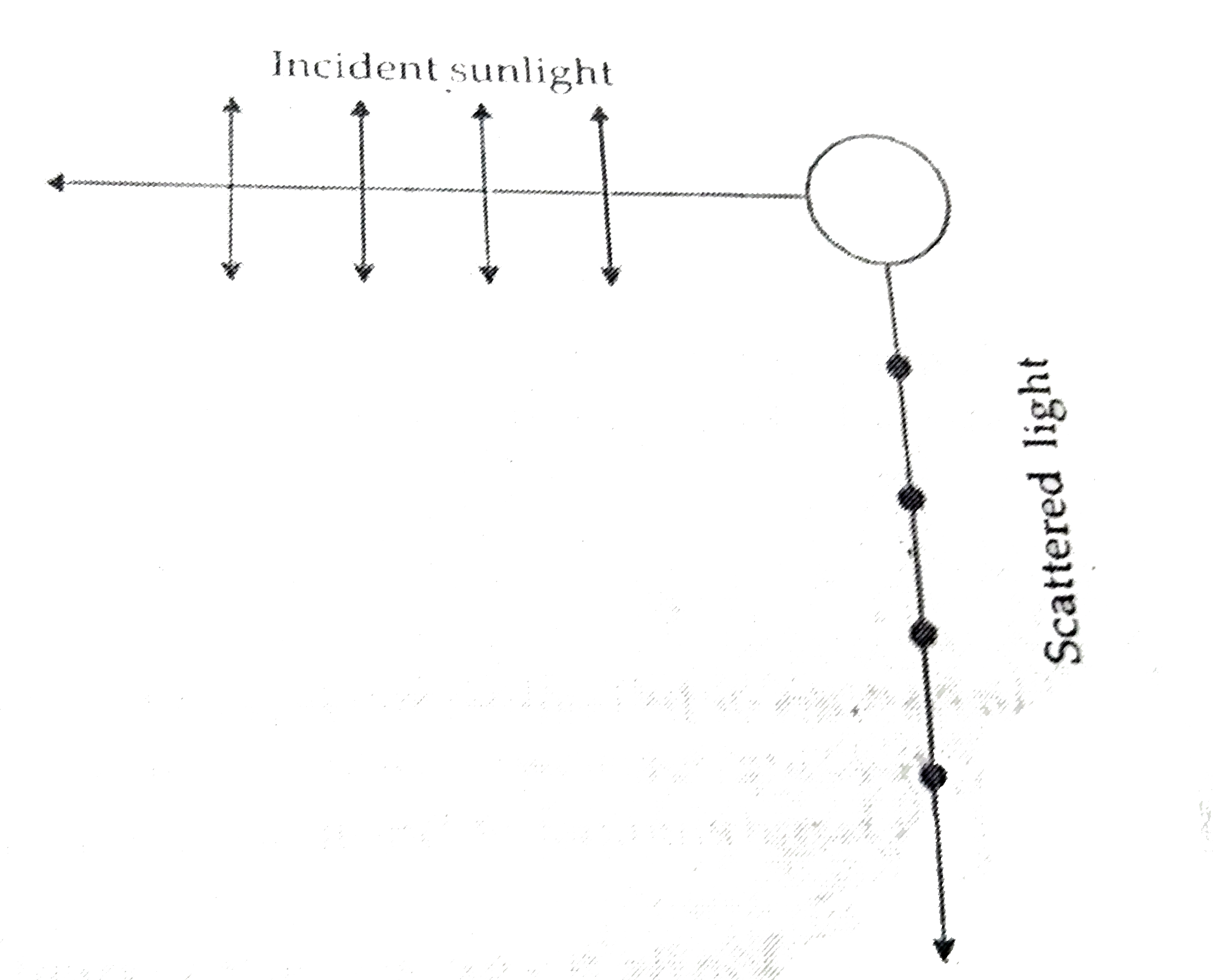 (b) If the unpolarised light is incident on a polaroid, the intensity is reduced by half. Even if the polaroid is rotated by angle `theta` the average over `cos^(2) theta = (1)/(2)`. Thus, from Malus' Law : I = `I_(0) cos^(2) theta` Or `I = I_(0)cos^(2)theta` `= I_(0) (cos^(2) theta) = (I_(0))/(2)` Thus, the intensity of the transmitted light remains unchanged when the polaroid is rotated. |
|