

Saved Bookmarks
| 1. |
(a) What is meant by plane polarised light? An unpolarised light is incident at an angle theta on the surface of glass of refractive index n. If the reflected and refracted rays are perpendicular to each other, then obtain the relationship between n and theta. (b) Two polaroids P1 and P2 are placed in a crossed position. Unpolarised light of intensity I_(0) is incident on P_(1). If P_(2) is rotated through an angle theta about the direction of propagation of light, keeping P_(1) fixed, plot the graph of intensity of light for 0°lt theta < 360° which is (i) transmitted by P_(1) and (ii) transmitted by P_(2). |
|
Answer» <P> Let an unpolarised light be incident at an angle `theta` on the surface of glass of refractive index . n. such that the reflected and refracted rays are perpendicular to each other. Then as shown in adjoining figure. `angletheta+angler=pi/2rArrangler=pi/2-angletheta` As per Snell.s law of refraction, we can write `(sintheta)/(sinr)=n` `rArr(sintheta)/(sin(pi/2-theta))=nrArr(sintheta)/(costheta)=nrArrtantheta=n` 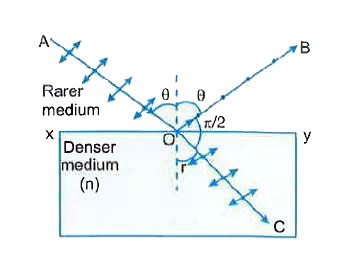 The RELATION n = tan `theta` is known as Brewster.s law and under this condition the reflected light is completely plane polarised one as shown in figure. (b) Here intensity of unpolarised light = `I_(0)` (i) Intensity of light TRANSMITTED by `P_(1),I_(1)=(I_(0))/2` and this intensity does not change on rotating `P_(2)`. (ii) Intensity of light transmitted by `P_(2),I_(2)=I_(1)cos^(2)theta` and it changes with change in VALUE of `theta`. Variation of `I_(1)` and `I_(2)` is shown below : 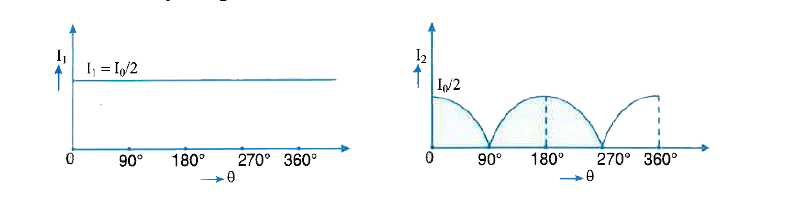
|
|