

Saved Bookmarks
| 1. |
A white solid A reacts with dilute H_(2)SO_(4) to produce a colourless gas B and a colourless solution C. the reaction between B and acidified dichromate yields a green solution and a slightly coloured precipitate D. the substance D, when burnt in air, gives a gas E which reactswith B to yield D and a colourlesss liquid. anhydrous copper sulphate turns blue with this colourless liquid. the addition of aqueous NH_(3) or NaOH toC produces a precipitate that dissolves in an excess of the reagent to form a clear solution. Q. What would happen if the gas E were passed through an acidified KMnO_(4) solution? |
|
Answer» Bleaching of the permangnate solution without any precipitation `H_(2)SO_(4)` suggets that the substance is a zinc salt. thus, A is most likely ZnS. let us go through the reactions now. 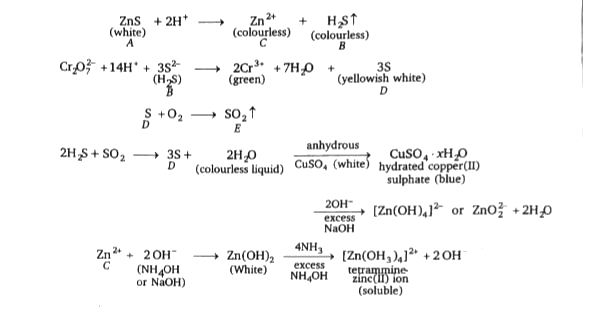
|
|