

Saved Bookmarks
| 1. |
a.Why do nucleophiles (Nu^(overset(..)Θ)) add to the (C=C) of alpha-beta-unsaturated carbonyl compounds but not to alkenes ? b.Explain the formation of product in the following reaction: CH_(3)CHunderset((A))= CHCHO overset(overset(Θ)(OD)//D_(2)O)rarr underset((B))underset(("Tetradecuterated compound"))(CD_(3)CH=CD.CHO) c.In the following reaction, three isomers are present in the equilibrium. Which is the most stable ? d.Explain why Michael addition is 3,4-addition. |
Answer» Solution :a.`(Nu^(overset(..)Θ))`adds to the `beta`-C atom to give resonance-stabilised CARBANION enolate.  `Nu^(Θ)` adds to alkene to give localised carbanion (not resonance stabilised), has a very high energy, and is not formed easily. 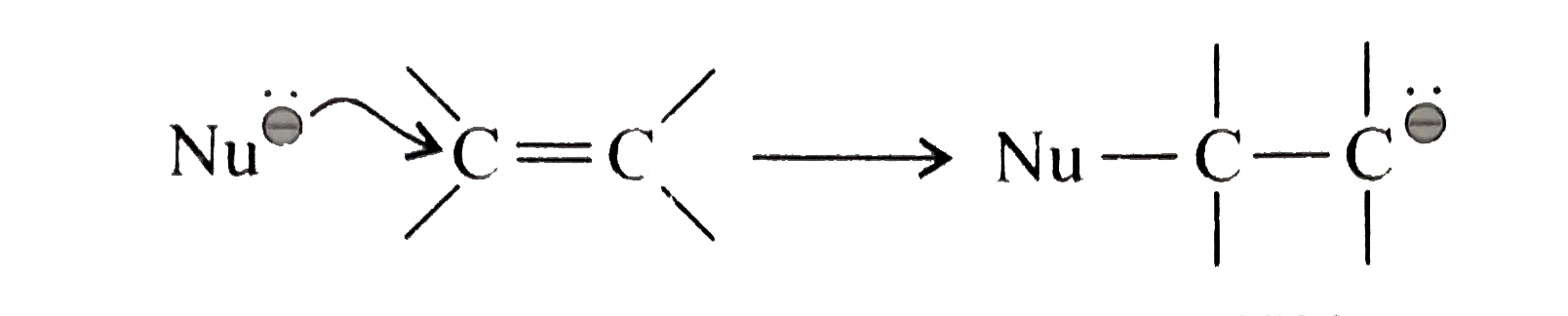 B. The H atom of Me acide due to delocalisation of negative charge. 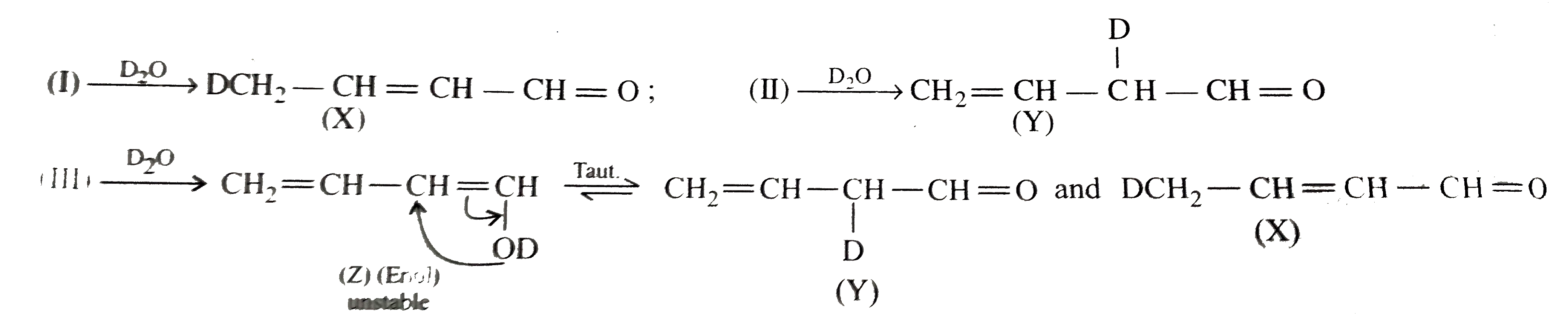 Three resonating structure I, II and III with negative charge can accept D form `D_(2)O` to give three products. X, Y, and Z. (I) `overset(D_(2)O)rarr DCH_(2)-UNDERSET((X))CH =CH-CH=O`,(II)`overset(D_(2)O)rarr CH_(2)=underset((Y))CH-overset(D)overset(|)CH-CH=O` 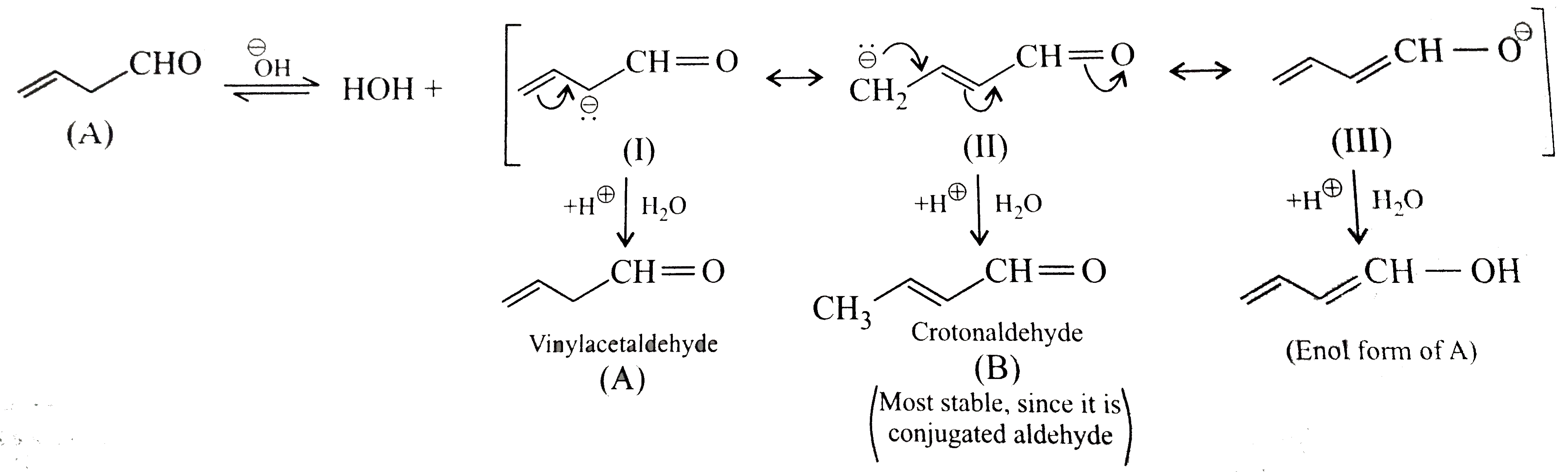 Unstable enol (Z) rearranges to (Y) and (X). When the reaction is performed REPEATEDLY with `O^(Θ)D`, carbanion enolate reforms and the reaction with `D_(2)O` ultimatley produces (B) `(D_(3)C-CH==CD-CH=O)`, tetradeuterated product. c.  d. In Michael reaction, nucleophilic addition reaction at `(C=O)` group of `alpha,beta`-unsaturated carbonyl compounds, GIVES 1,2-addition product (B), which rerranges to unstable intermediate product (C ) and is called 1,4-addition product, that ultimately gives product (D). So the addition in (D) actually is 3,4-and is called Micheel addition. 
|
|