

Saved Bookmarks
| 1. |
(a) With the help of a labelled digram, explain the working of a step-up transformer. Give reason to explain the following, (i) The core of the transformer is laminated. (ii) Thick copper wire is used in windings. (b) A conducting rod PQ of length 20 cmn and resistance 0.1 Omega rests on two smooth parallel rails of negligible resistance AA' and CC'. It can slide on the rails and the arrangement is positioned between the poles of a permanent magnet producing uniform magnetic field B=0.4T. The rails, the rod and the magnetic field are in three mutually perpendicular directions as shown in the figure. If the ends A and C of the rails are short circuited, find the (i) external force required to move the rod with uniform velocity v= 10 cm/s, and (ii) power required to do so. |
|
Answer» SOLUTION :(a) A step up transformer is shown here. It consists of two coils of enamelled copper wire wound on a laminated soft iron core. Number of turns in secondary coil is greater than that in primary coil When an alternating emf/voltage source is applied across the P coil, the input current and, hence, magnetic flux through P coil soft iron core keeps on changing with time. The changing magnetic flux GETS linked up with S coil through the iron core, which in turn producesinduced voltage across the secondary coil. It coupling of two coils is good then all flux lines across P coil link up with Scoil too. If at any time, the flux linked per unit tum of primary be `phi_(B)` then TOTAL magnetic flux of P coil, `phi_(P)=N_(P), phi_(E)" [where "N_P=" Total number of turns in P coil")` and instantaneous value of induced emf in P coil, `epsi_(p)=-(d phi_(P))/(dt)=-N_(P) (d phi_(B))/(dt)` If total number of turns in S coil be `N_S` then magnetic flux of S coil `phi_(s)= N_s. phi_(B)` and instantaneous value of induced emf in S coil, `epsi_(s)= (d phi_(s))/(dt)=-N_(s) (dphi_(B))/(dt)` For an ideal transformer `|epsi_(p)|`= input voltage `V_p and epsi_(s)=V_s` = output voltage obtained across secondary coil. Then, `|epsi_s|/|epsi_p|=V_s/V_p=N_s/N_p` Again for an ideal transformer input power output power `therefore V_(p). I_(p)=V_(s).I_(s)` `rArr V_(s)/V_(p)=I_(p)/I_(s)=N_(s)/N_(p)=k` (the transformer ratio) Since `N_(s) gt N_(p)` in a step up transformer, `V_(s) gt V_(p`) i.e, transformer ratio k has a value greater than unity. (i) The core of the transformer is laminated one so as to minimise setting up of eddy currents in it. (ii) Thick copper wire is used in windings of coils so that resistance of the coils is small and least possible electrical energy is dissipated as heat due to Joule.s heating. (b) Her length of rod l=20cm =0.2m, resistance `R=0.1 Omega`, magnetic field B=0.4T and uniform velocity or rod `v=10 CM s^(-1) =0.1ms^(-1)` (i) Induced current `I=(BLV)/(R)` and hence force required to move the rod `F=BIl =(B^(2) l^(2) v)/(R)=((0.4)^(2) xx (0.2)^(2) x(0.1))/(0.1) =6.4 xx 10^(-4)n` (ii) Power required `P=Fv=(6.4 xx 10^(-4)) xx 0.1=6.4 xx 10^(-5)W` 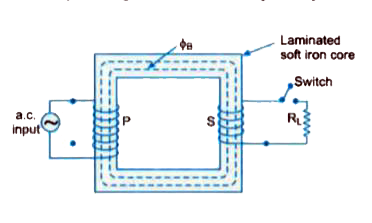
|
|