

Saved Bookmarks
| 1. |
A wooden block of mass 1 kg rests on a soft horizontal floor. When an iron cylinder of mass 20kg is placed on top of the block, the floor yields steadily and booth go down with an acceleration of 0.1ms^(-2). What is the action of the block on the floor (a) before and (b) after the floor yields? (Take g=10ms^(-2)). Identify the action and reaction pairs in the problem. |
Answer» Solution :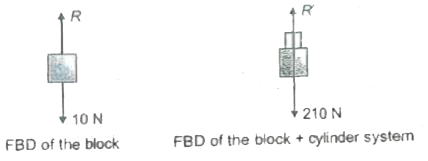 (a) The block is at REST on the floor. Its FBD shows two forces on it, Weight = mg `=1xx10` `=10N` and the normal force R of the floor on the block. Net force = 0, According to first law `rArr R=10N` directed upwards (b) The system (block + cylinder) accelerates DOWNWARD with `0.1ms^(-2)`. The FBD shows weight of hte system `(=(20+1)xx10=210N)` and normal force R' by the floor. FBD does not show internal forces between the block and the cylinder. `210-R'=21xx0.1 ""` (Applying second law to the system) `R'=207.9N` Action of the system on the floor = 207.9 N vertically downwards Action-reaction pairs For (a) : (i) Action : Force of gravity (10N) on the block by the earth. Reaction: Force of gravity on the earth by the block. (ii) Action: Force on the floor by the block. Reaction: Force on the block by the floor. For (b): (i) Action: The force of gravity (210 N) on the system by the earth. Reaction: The force of gravity (210 N) on the earth by the system. (ii) Action: Force on the floor by the system. Reaction: Force on the system by the floor. Remember that an action-reaction pair consists of mutual forces which are always equal and opposite between two bodies. The forces on the same BODY CONNOT constitute an action-reaction pair. For example, the force of gravity on the block in (a) or (b) and the normal reaction on the block by the floor are not action - reaction pairs. These forces are equal and opposite for (a) as the block is at rest. For(b), they are notsame. Weight = 210 N, while R' = 207.9 N. |
|