

Saved Bookmarks
| 1. |
ABC is an isosceles right angled triangular refecting prism of average refractive index mu. When incident rays on face AB are parallel to face BC, then they emerges from Face AC, which are also parallel to Face BC as shown in figure-I. The prims capable to do so, known as Dove Prism. In figure II, the Dove Prism is used for dispersion of incident light containing red colour and violet colour only. The red colour and violet colour lights are separated (displaced) on screen by a distance Deltal. In reality, each ray of any colour has some width, which can be designated as d. It is clear that an observer candistinguish the red and violet rays that emerges from prism only if Deltalged. Otherwise the bundles of rays will overlap and mix. [Given for Dove Prism in figure II: mu_(R)=sqrt(5/2),Deltamu=mu_(V)-mu_(R)=0.02, sqrt(5)=2.25, EF1m and AB=4cm] Find the maximum value of width d of bundle of rays that can be resolved at the outlet of Dove Prism as shown in the figureII |
|
Answer» `2.25xx10^(-3)m` `/_EMD+/_MDE=/_BEM` `implies beta(90-alpha)=45^(@)` `impliessin(beta+45^(@))gt(1/(mu))` `implies sin beta+cosbeta gt (sqrt(2))/(mu)`……….(1) 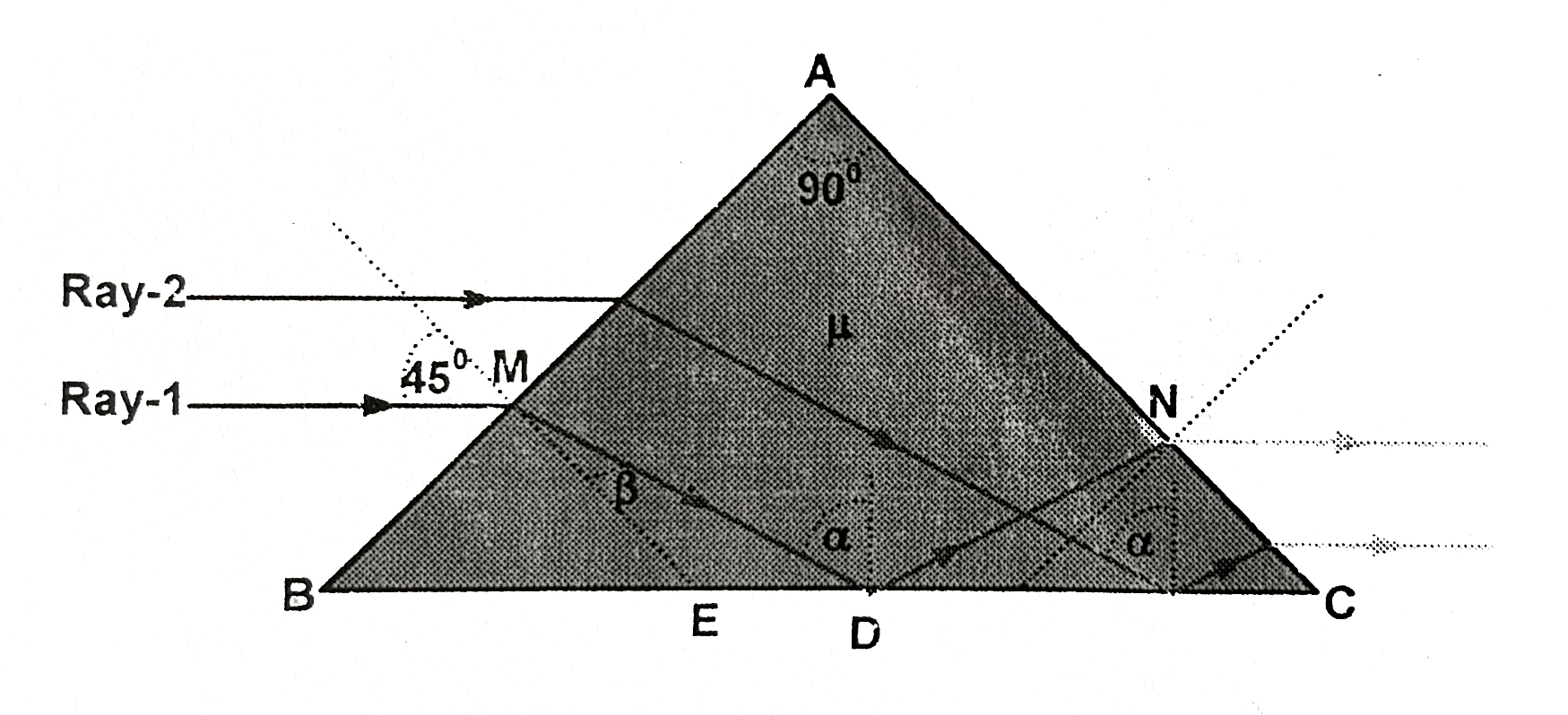 According to law of refraction at point `M`, we can write `1xxsin(45^(@))=musin betaimpliessin betas=1/(musqrt(2))impliescosbeta=sqrt(1-1/(2MU^(2))` Putting these value in equation (1), we have `1/(musqrt(2))+sqrt(1- 1/(2mu^(2))) gt (sqrt(2))/(mu)implies sqrt(2mu^(2)-1) gt 1implies mu gt 1` In figure II: Replace the Dove PRISM, by glass cube of side as `AB` 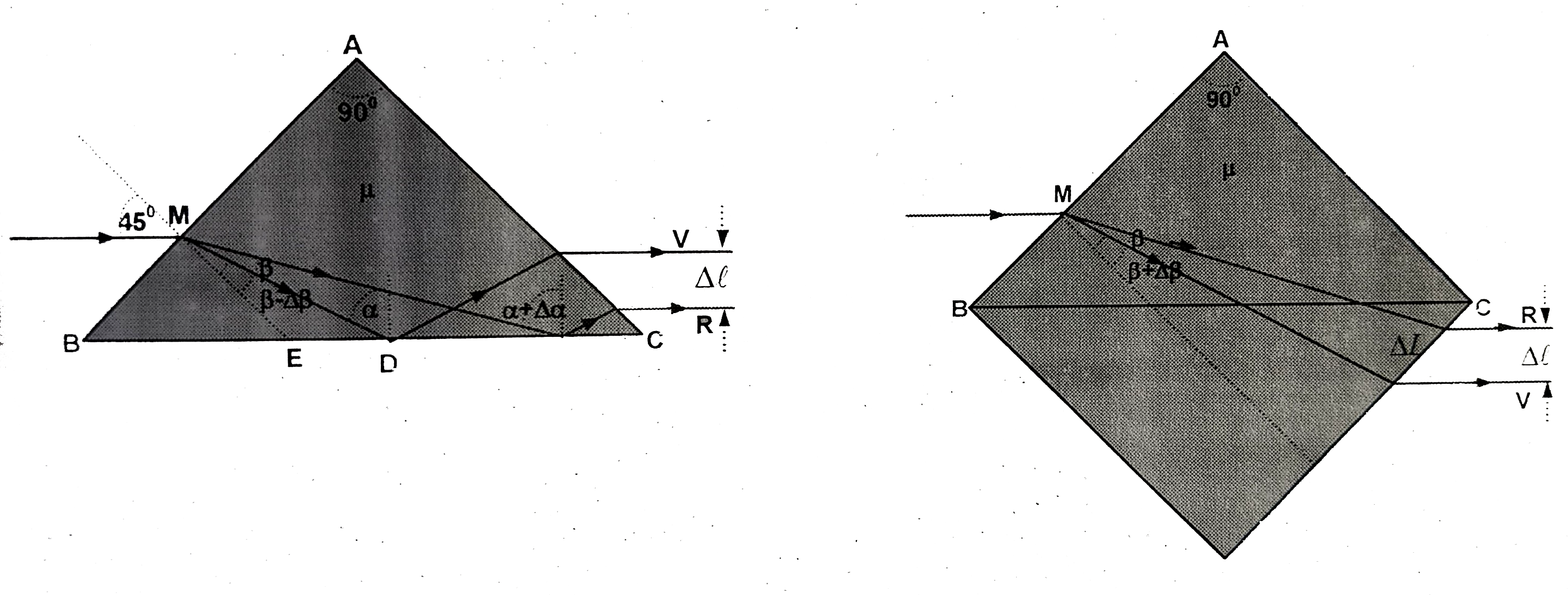 `Deltal=(DeltaL)/(sqrt(2))`.............(2) From geometry, we can write `sinbeta=1/(mu_(R)sqrt(2))` and `sin (beta-Deltabeta)=1/((mu_(R)+Deltamu_(R))sqrt(2))` `DeltaL=a tan beta-a tan (beta-Deltabeta)=1/(sqrt(2mu_(R)^(2)-1))-a/(sqrt(2(mu_(|r)+Deltamu)^(2)-1))` `impliesDelta=a/(sqrt(2mu_(R)^(2)-1))(1-sqrt((2mu_(R)^(2)-1)/(2(mu_(R)+Deltamu)^(2)-1)))=a/(sqrt(mu_(R)^(2)-1))(1-sqrt((2mu_(R)^(2)-1)/(2(mu_(R)+Deltamu)^(2)-1)))` `impliesDeltaL=a/(sqrt(2mu_(R)^(2)-1))(1-sqrt(2mu_(R)^(2)-1)/(2mu_(R)^(2)+4mu_(R)Deltamu+2(Deltamu)^(2)-1))` Neglecting the value `(Deltamu)^(2)`, we have `impliesDelta=a/(sqrt(2mu_(R)^(2)-1))(1-sqrt(1/(1+(4mu_(R)Deltamu)/(2mu_(R)^(2)-1))))-a/(sqrt(2m_(R)^(2)-1))(1-{1+(4mu_(R)Deltamu)/(2mu_(R)^(2)-1)}^(-1/2))` Expand binomially, we have `impliesDeltaL=(2amu_(R)Deltamu)/((2mu_(R)^(2)-1)^(3/2))` Putting this value in equation (2), we have `Deltal=(sqrt(2)amu_(R)Deltamu)/((2mu_(R)^(2)-1)^(3/2))` Secondmethod: `DeltaL=(d/(dbeta)(a tan beta))xxDeltabeta` `DeltaL=(asec^(2)beta)xxDeltabeta` Also `sinbeta=1/(sqrt(2)mu_(R))` `impliescos beta Deltabeta=1/(sqrt(2)mu_(R)^(2))Deltamu` `impliesDeltaL=(asec^(2)betaxxDeltamu)/(sqrt(mu_(R)^(2)cosbeta` `impliesDeltaL=(2amu_(R)Deltamu)/((2mu_(R)^(2)cosbeta)` THIRD method: `Deltal=(DeltaL)/(sqrt(2)), sin alpha = 1/ (mu_(r) sqrt(2)), sin beta=1/(mu_(v)sqrt(2))` `DeltaL=atan alpha =a tan beta` `=[1/(sqrt(2mu_(r)^(2)-1))-1/(sqrt(2mu_(v)^(2)-1))]` `=a[1/2-1/(2sqrt(1+mu_(r)Deltamu))]` `=a/2 [a-(1+mu_(r)Deltamu)^(-1//2)]` `=a/2[1-1+1/2mu_(r)Deltamu]` `=a/4mu_(r)Deltamu` `Deltal=(DeltaL)/(sqrt(2))=a/(4sqrt(2)) mu_(r)Deltamu=(4cm)/(4sqrt(2))xx(sqrt(5))/(sqrt(2))xx2/100` `=(sqrt(5))/100 cm = sqrt(5)xx10^(-4)m` `=2.25xx10^(-4)m` Since : `Deltal ge d` `impliesd le 2.25xx 10^(-4)m` `sqrt(2mu_(v)^(2)-1)=sqrt(2(mu_(r)+Deltamu)^(2)-1)` `impliessqrt(4+4mu_(r)Deltamu)[(Deltamu)^(2)~~0]` `=2sqrt(1+mu_(r)Deltamu)` 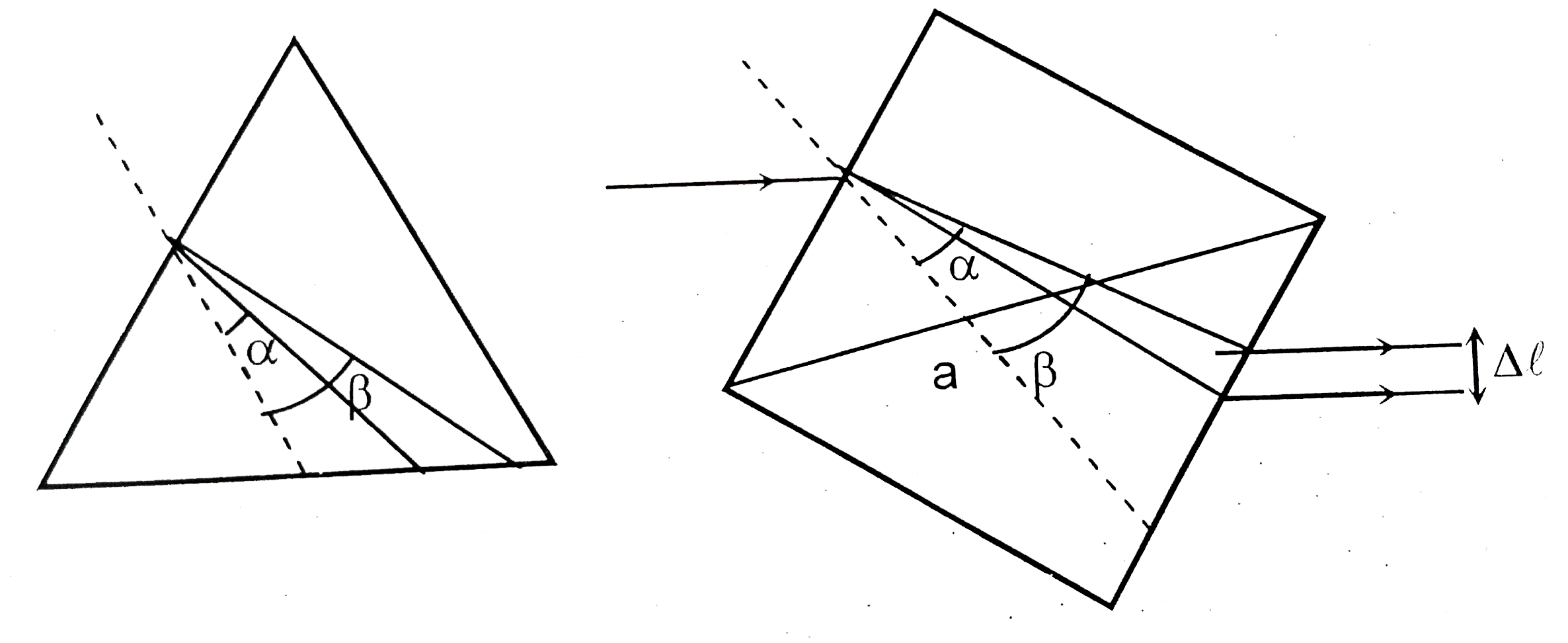
|
|