

Saved Bookmarks
| 1. |
Ac^(227) has a half- life of 22.0 years with respect to one leading . To Th^(227) and the other to Fr^(227). The percentage yields of these two daughter nuclides are 2.0 and 98.0, respectively . What are the decay constants (lambda) for each of the separate paths ? |
|
Answer» Solution :For the radioactive decay of `A` into `B` and `C` by two PARALLEL paths So, `(-d[A])/(dt)=lambdaN....(i)` `(+d[B])/(dt)=lambda_(1)N.....(ii)` `(+d[C])/(dt)=lambda_(2)N....(III)` where `lambda,lambda_(1) , `and `lambda_(2)` are radioactive decay constants, respectively, and `N` is the number of atoms of `A` at any GIVEN time. THUS, `(+d[A])/(dt)=(d[B])/(dt)+(d[C])/(dt)` `:. lambdaN=lambda_(1)N+lambda_(2)N` `:. lambda=lambda_(1)+lambda_(2)N` From eqs. `(ii)` and `(iii)`, we get `(d[B])/(d[C])=(lambda_(1))/(lambda_(2))` On integration ,we get `([B])/([C])=(lambda_(1))/(lambda_(2))` For decay of `Ac^(227)` into `TH^(227)` and `Fr^(223)` , on the basis of given data `(lambda_(1))/(lambda_(2))=(2.0)/(98.0) ....(iv)` and `lambda=(0.693)/(t_(1//2))=(0.693)/(22)=0.0315year^(-1)` ltbr. So,` 0.0315=lambda_(1)+lambda_(2) ...(v)` On solving Eqs. `(iv)` and `(v)`, we get `lambda_(1)=6.3xx10^(-4)year^(-1)` and `lambda_(2)=0.03087year^(-1)` 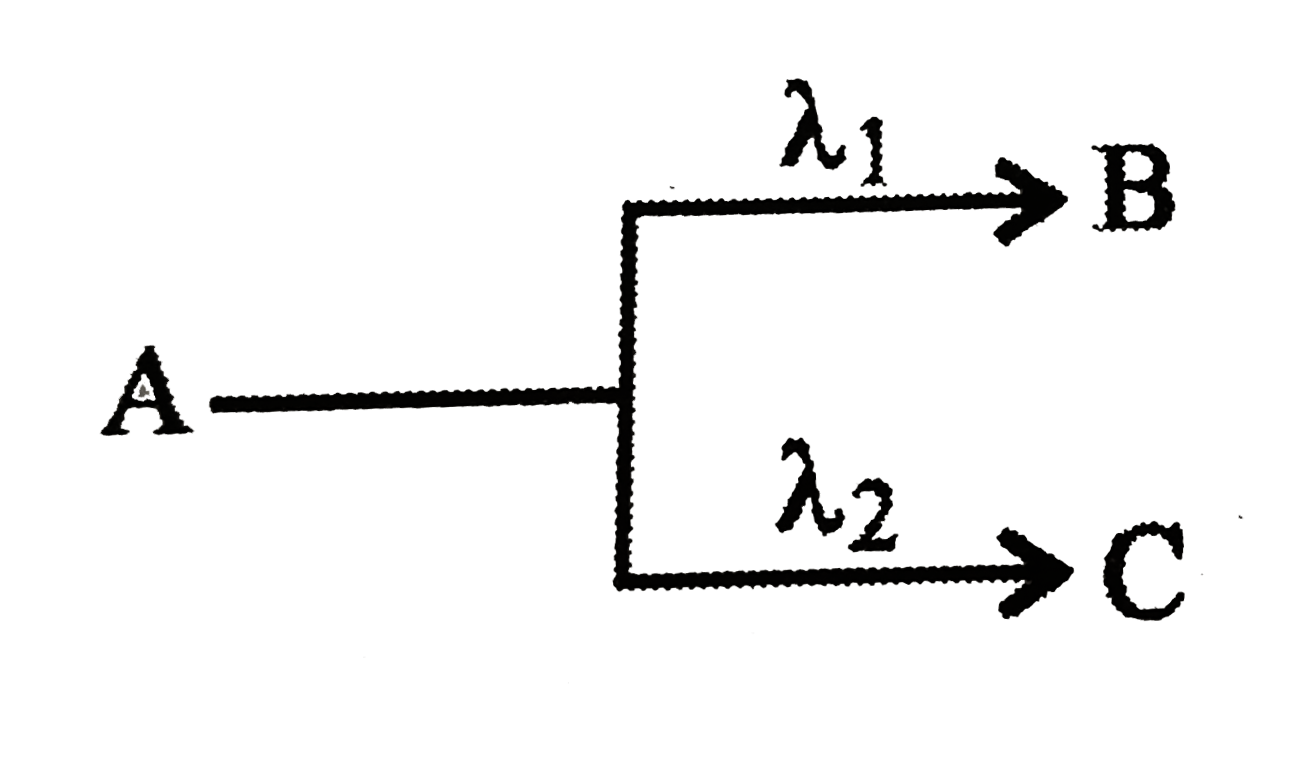
|
|