

Saved Bookmarks
| 1. |
Account for the following: (a) Molecular nitrogen N_2is not particularly reactive. (b) H_3PO_3 is diprotic.(c) Nitrogen forms no pentahalides like phosphorus. (d) Water has higher boiling point than H_2S . |
|
Answer» Solution :(a) Molecular nitrogen is not reactive. Molecular nitrogen has TRIPLE bond `N_ (N -= N)`and has non-polar CHARACTER. Due to the presence of triple bond, it has very high bond dissociation energy (945 kJ `"mol"^(-1)` ) and, therefore, it does not react with other elements under normal conditions. However, it may react at high temperatures. (b) `H_3PO_3`has the structure given below: 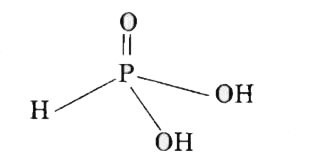 In this structure, it has only two - OH groups and therefore, gives only two ionisable `H^+`ions in aqueous solution : `H_2PO_3 iff H^(+) + H_2PO_(3)^(-)` `H_2PO_(3)^(-) iff H^(+) + HPO_(3)^(2-)` It gives only two series of salts `NaH_2PO_3` and `Na_2 HPO_3`and behaves as dibasic. (c) The electronic configuration of nitrogen is `1s^(2) 2S^(2) 2p_(x)^(1) 2p_(y)^(1) 2p_(z)^(1)` The outermost shell does not contain d-orbitals and therefore, nitrogen cannot extend its octet. Hence, it can form maximum of four bonds and cannot form pentahalides. On the other hand, P has vacant d-orbitals in its outermost shell and therefore, can extend its octet. Hence, pentahalides of phosphorus are known. (d) In `H_2O` , hydrogen is bonded to electronegative element oxygen and therefore, it can form hydrogen bonds. As a result, WATER exists as associated molecules and therefore, exists as a liquid.  On the other hand, `H_2S`has negligible tendency to form hydrogen bonding because of low electronegativity of S. The molecules are, therefore, held up by only weak van der Waals” forces. Therefore, it exists as gas. Therefore, water has higher boiling point than `H_2 S` . |
|