

Saved Bookmarks
| 1. |
Account for the following: (i) pK_(a) of aniline is more than that of methylamine. (ii) Ethylamine is soluble I water whereas aniline is not. (iii) Methylamine in water reacts with ferric chloride to precipitate hydrated ferric oxide. (iv) Although amino group is o, p-directing in aromatic substitution reactions, aniline on nitration gives a substantial amount of m-nitroaniline. (v) Aniline does not undergo Friedel-Crafts reaction. (vi) Diazonium salts of aromatic amines are more stable than those of aliphatic amines. |
|
Answer» Solution :(i) In aniline, the lone pair of electrons on the N-atom is delocalized over the benzene ring. As a result, electron density on the NITROGEN decreases. In contrast, in `CH_(3)NH_(2)`, +I-effect of `CH_(3)` increases the electron density on the N-atom. therefore, aniline is a weaker base than methylamine and hence its `pK_(a)` value is higher than that of methylamine. (ii) Ethylamine dissolves in waer DUE to intermoleclar H-bonding as shown below: 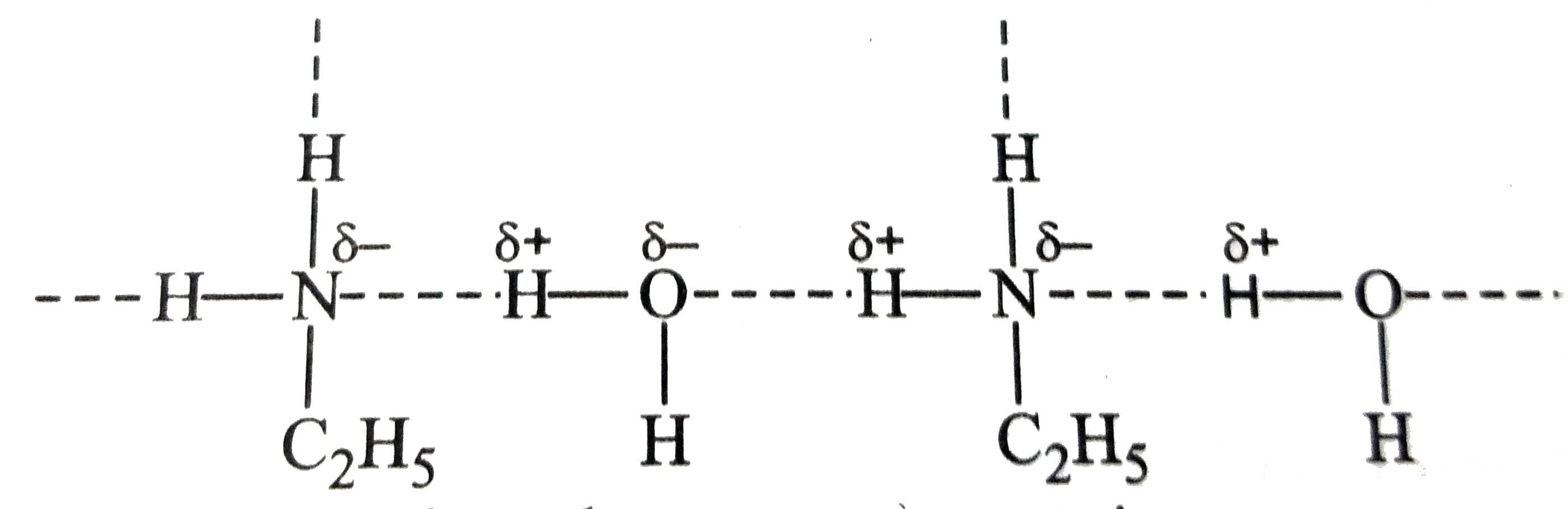 However, in aniline, due to the large hydrophobic part, i.e., hydrocarbon part, the extent of H-bonding decreases considerable and hence aniline is insoluble in water. (iii) Methylamine being more basic than water, saccepts a proton from water liberating `OH^(-)` ions.  These `OH^(-)` ions combines with `Fe^(3+)` ions present in `H_(2)O` to form brown ppt. of hydrated ferric oxide. `FeCl_(3) to Fe^(3+)+3Cl^(-)` `2Fe^(3+)+6OH^(-) to underset("Hydrated ferric oxide (Brown ppt.)")(2Fe(OH)_(3)" or "Fe_(2)O_(3).3H_(2)O)` (iv) Nitration is usually carried out with a mixture of conc.`HNO_(3)` + conc. `H_(2)SO_(4)` (nitrating mixture). In presence of these acids, most of aniline gets protonated to form anilinium ION. Therefore, in presence of acids, the reaction mixture consists of aniline ion. Now `-NH_(2)` group in aniline is o, p-directing and activating while the `-overset(+)(N)H_(3)` group in anilinium ion is m-directing and deactivating , the nitration of anilinium ion gives m-nitroaniline. In actual practice, approx. a 1:1 mixture of p-nitroaniline and m-nitroaniline is obtained. 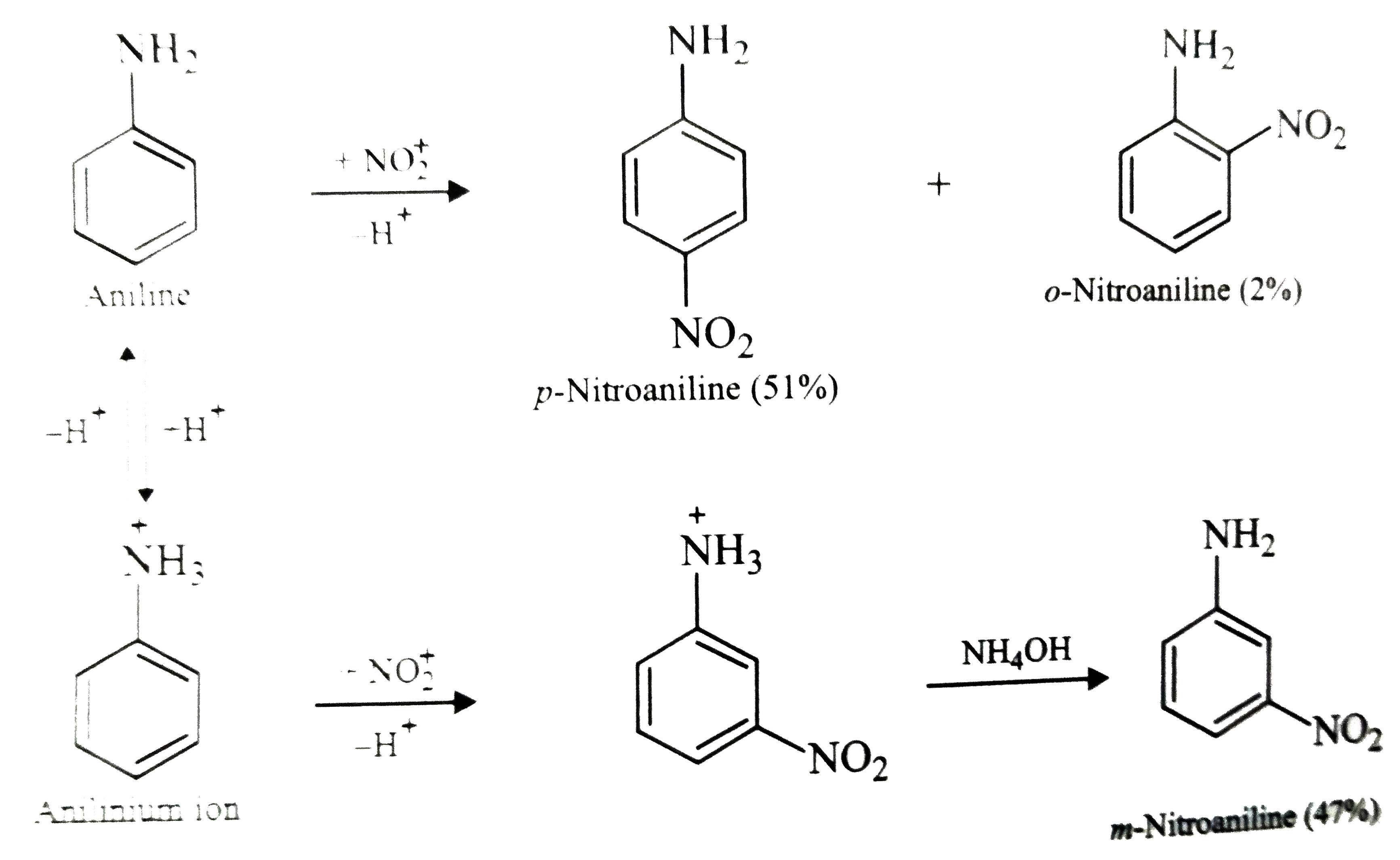 Thus, nitration of aniline gives a substantial AMOUNT of m-nitroaniline due to protonation of the amino group. (v) Aniline being a Lewis base reacts with Lewis acid `AlCl_(3)` to form a salt. 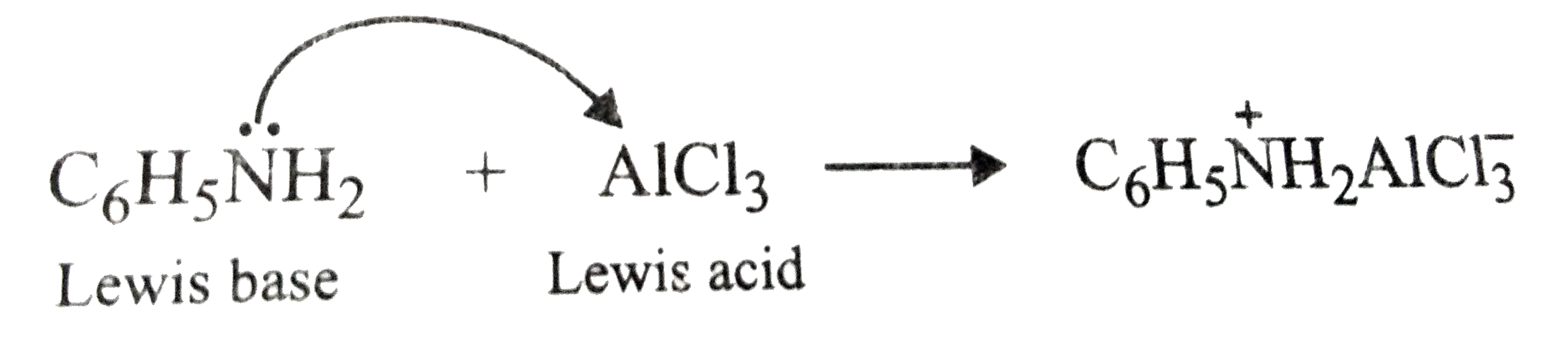 Due to the presence of a positive charge on N atom in the salt, the group `-overset(+)(N)H_(3)AlCl_(3)^(-)` acts as a strongly deactivating group. As a result, it reduces the electron density in the benzene ring and hence aniline does not undergo F.C. (alkylation or acylation) reaction. (vi) The diazonium salts of aromatic amines are more stable than those of aliphatic amines due to dispersal of the positive charge on the benzene ring as shown below: 
|
|