

Saved Bookmarks
| 1. |
An electric field E is produced between two parallel plates having a separation d as shown. (a) With what minimum speed should an electron be projected from the lower plate in the direction of field so that it may reach the upper plate ? (b) Suppose the electron is projected from the lower plate with the speed calculated in part (a). The direction of projection makes an angle of 60^(@)with the field. Find the maximum height reached by the electron. (c ) After how much time , the electron again strikes the lower plate ? (d) Horizontal distance travelled by the electron in time calculated in part (c ). Charge on electron : e ,mass of electron : m, consider only electric force. |
|
Answer» Solution :(a) Force on electron `F = eE`, in downward direction. Let the electron be thrown with speed `u`. Retardation of electron `a = (e E)/(m)` The electron just reaches the upper plate i.e. its velocity at upper plate is zero. `v^(2) = u^(2) - 2 as` `0 = u^(2) - (2e Ed)/(m) rArr u = sqrt((2e Ed)/(m))` Note : This problem is SIMILAR to motion under gravity ,here `g = eE//m`. (B) This is the case of motion in a plane and similar to PROJECTILE motion , here `g = eE//m`. `y`-direction : Velocity of electron at highest point `= 0`. `v_(y)^(2) = u_(y)^(2)- 2 a_(y) s` when `s = H_(max) ,v_(y) = 0`. `0 = (u sin 30^(@))^(2) - 2 (e E)/(m) H_(max)` `H_(max) = (u^(2) sin^(2) 30^(@))/(2 eE//m) = (2eEd)/(m) .(1)/(4) .(1)/(2e E//m)` `= (d)/(4)` (c) `O` to `A` : Displacement in y-direction is zero. `y = u_(y)t - (1)/(2) a_(y) t^(2)` `0 = u sin 30^(@) t - (1)/(2) a_(y) t^(2)` `t = (2 u sin 30^(@))/(a_(y)) = 2 sqrt((2 eEd)/(m)) .(1)/(2) .(1)/(eE//m)` `= sqrt((2 MD)/(eE))` (d) Distance `OA : x` -direction `x = u_(x)t = u cos 60^(@) t` `= sqrt((2 eEd)/(m)) .(1)/(2) sqrt((2md)/(eE)) = d` Note : This case is similar to projectile motion , MAXIMUM height , time of flight and range are being asked. 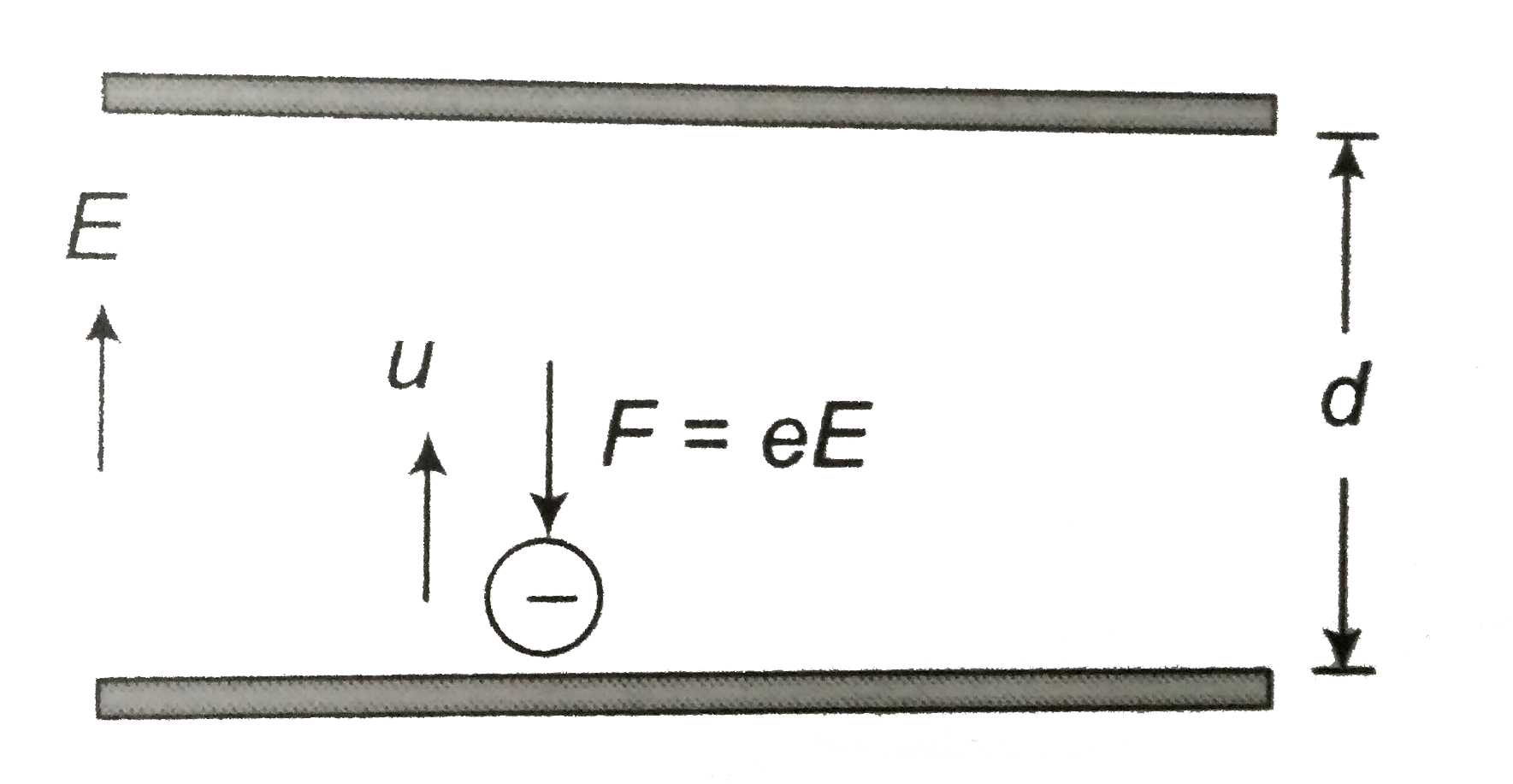 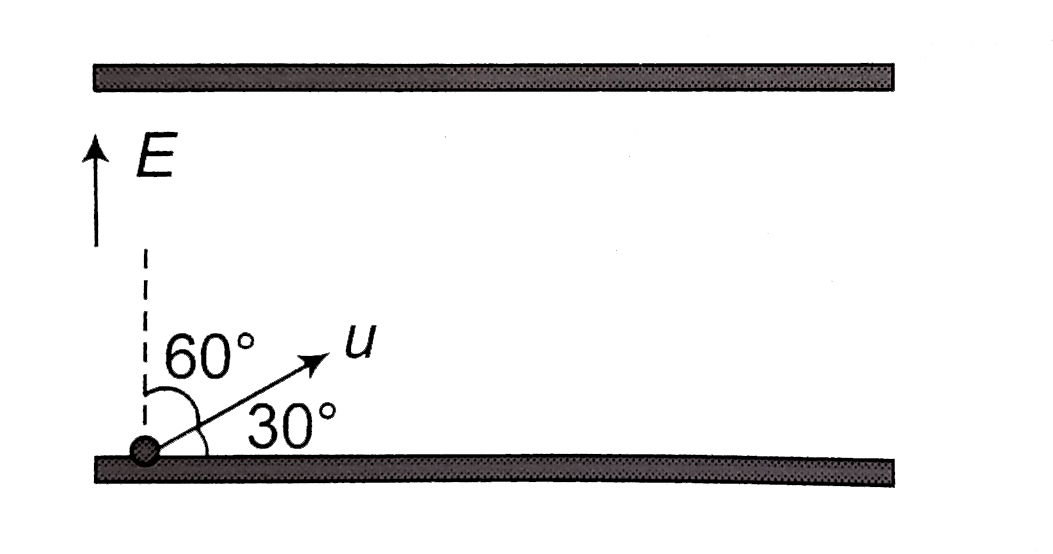 
|
|