

Saved Bookmarks
| 1. |
An electric spark jumps along a straight line of length L = 10 m, emitting a pulse of sound that travels radially outward from the spark. (The spark is said to be a line source of sound.) The power of this acoustic emission is P = 1.6 xx 10^4W. (a) What is the intensity I of the sound when it reaches a distance r = 12 m from the spark? (b) At what time rate P_A is sound energy intercepted by an acoustic detector of area A_d = 2.0 cm^2?, aimed at the spark and located a distance r = 12 m from the spark? |
Answer» Solution :(1) Let us CENTER an imaginary cylinder of radius R = 12 m and length L = 10 m (open at both ends) on the spark, as shown in Fig. Then the intensity I at the cylindrical surface is the ratio P/A, where P is the time rate at which sound energy passes through the surface and A is the surface area. (2) We assume that the principle of conservation of energy applies to the sound energy. This means that the rate P at which energy is transferred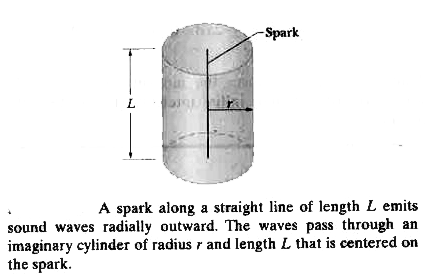 through the cylinder must equal the rate `P_s` at which energy is emitted by the SOURCE. Putting these ideas together and noting that the area of the cylindrical surface is `A = 2pir L` ,we have `I = P/A = (P_s)/(2pi r L)` This tells us that the intensity of the sound from a line source decreases with distance r (and not with the square of distance r as for a point source). Substituting the GIVEN data, we find `I = (1.6 xx 10^4 W)/(2pi (12m )(10 m))` ` = 21.2 W//m^2 ~~ 21 W//m^2` (b)We know that the intensity of sound at the DETECTOR is the ratio of the energy transfer rate `P_d` there to the detector.s area `A_d` : `I = (P_d)/(A_d)` We can imagine that the detector lies on the cylindrical surface of (a). Then the sound intensity at the detector is the intensity I( = `21.2 W//m^2`) at the cylindrical surface. Solving Eq. for `P_d` gives us `P_d= (21.2 W//m^2) (2.0 xx 10^(-4) m^2) = 4.2 mW` |
|