

Saved Bookmarks
| 1. |
An electron of mass m_e, revolves around a nucleus of charge +Ze. Show that it behaves like a tiny magnetic dipole. Hence, prove that the magnetic moment associated with it is expressed as vec(mu) = - e/(2 m_e) vecL, where vecL is the orbital angular momentum of the electron. Give the significance of negative sign. |
|
Answer» Solution :We KNOW that a revolving electron constitutes an electric current GIVEN by `I = e/T = (ev)/(2 pi r)` where `T = (2 pi r)/v` = peroid of revolution of electron revolving in a circular orbit of radius r with a speed v. `:.` Magnetic moment `(mu_l)` associated with this circulating current, `mu_l = I CDOT A = (ev)/(2pi r) cdot pi r^2 = (evr)/(2)` As an electron revolving is an anticlockwise direction is equivalent to current in clockwise direction, hence in accordance with right hand rule the magnetic moment is in a direction perpendicular to plane of paper (or plane of orbit) directed inward. The above relation may also bewritten as : `mu_l = (e v rm)/(2m ) = e/(2m) cdot l` and in vector notation, `vec(mu)_(l) = -e/(2m) cdot vecl ,` where `l = m v r` = orbital ANGULAR momentum of the electron around the nucleus . The -ve sign applied here INDICATES that the angular momentum of the electorn is opposite in direction to the magnetic moment. 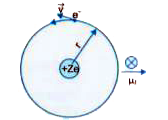
|
|