

Saved Bookmarks
| 1. |
An equil convex lens of focal length 10 cm (in air) and R.l.4//3 is put at a small opening on a tube of length 1 m fully filled with liquid of R.l.4//3.A concave mirror of radius of curvature 20 cm is cut into two halves m_(1) and m_(2) and placed at the end of the tube. m_(1) & m_(2) are placed such that thir principal axis AD, and CD respectively are separated by 1 mm each from the principal axis of the lens. A slit S placed in air illuminates the lens with light of frequency 7.5xx10^(14) Hz. The light reflected from m_(1) and m_(2) forms interference pattern on the left end EF of the tube. O is an opaque substance to cover the hole left by m_(1) & m_(2). Find : (a) the position of the iamge formed by lens water combination. (b) the distance between the images formed by m_(1) & m_(2). (c) width of the fringes on EF |
|
Answer» `(1)/(f)=(mu-1)((1)/(R)-(1)/(-R)) rArr (1)/(10)=((3)/(2)-1)((2)/(R)) rArr R=10 cm`. Now 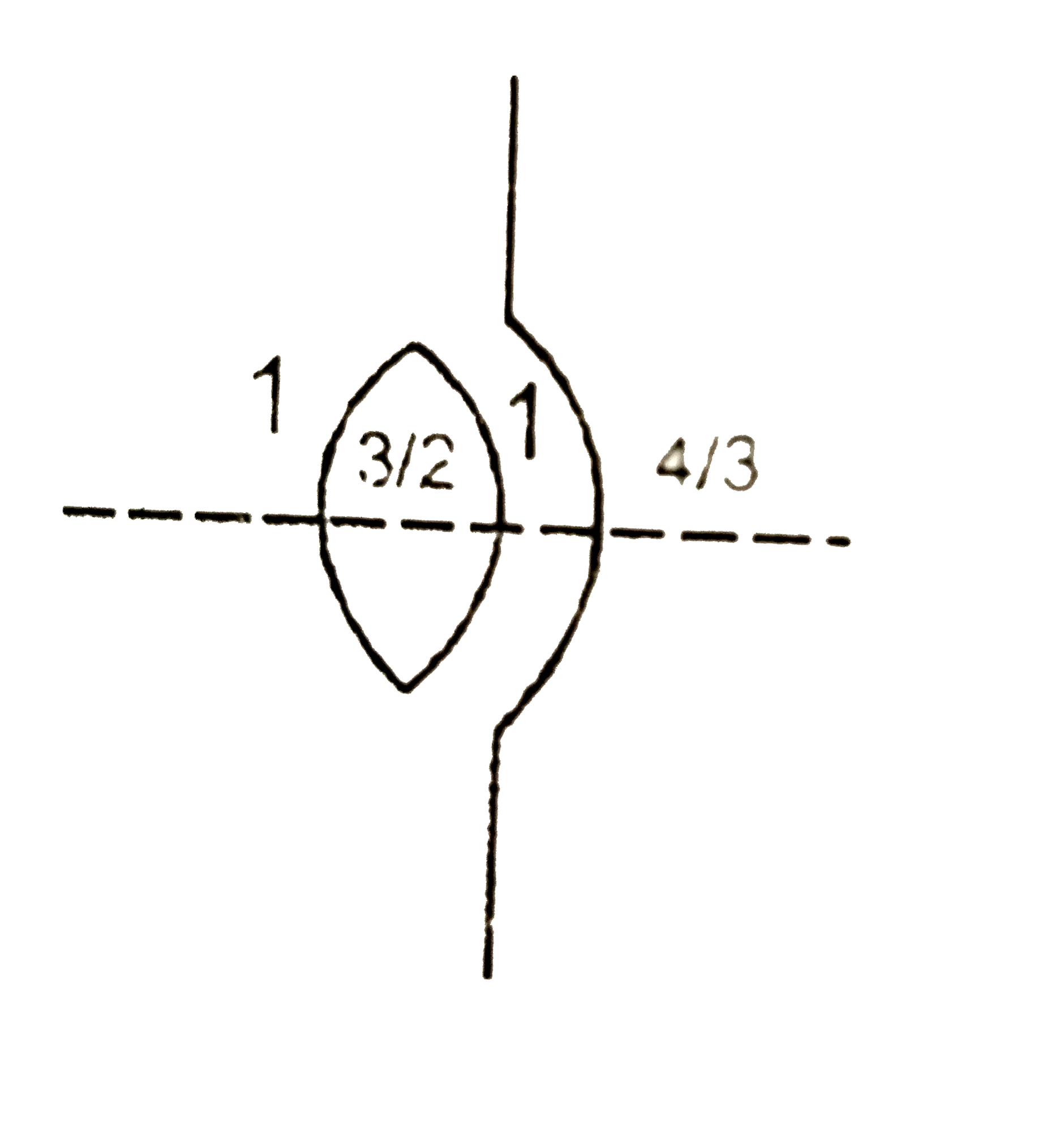 for lins : `(1)/(V)-(1)/(-20)=(1)/(10) rArr (1)/(V)=(1)/(20)` `rArr` for surface of tube (of `R=10 cm`.) `(mu_(2))/(V)-(mu_(1))/(u)=(mu_(2)-mu_(1))/(R) rArr (4//3)/(V)-(1)/(+20)=(4//3-1)/(-10) rArr V=+80 cm`. (b) Now for mirrors. 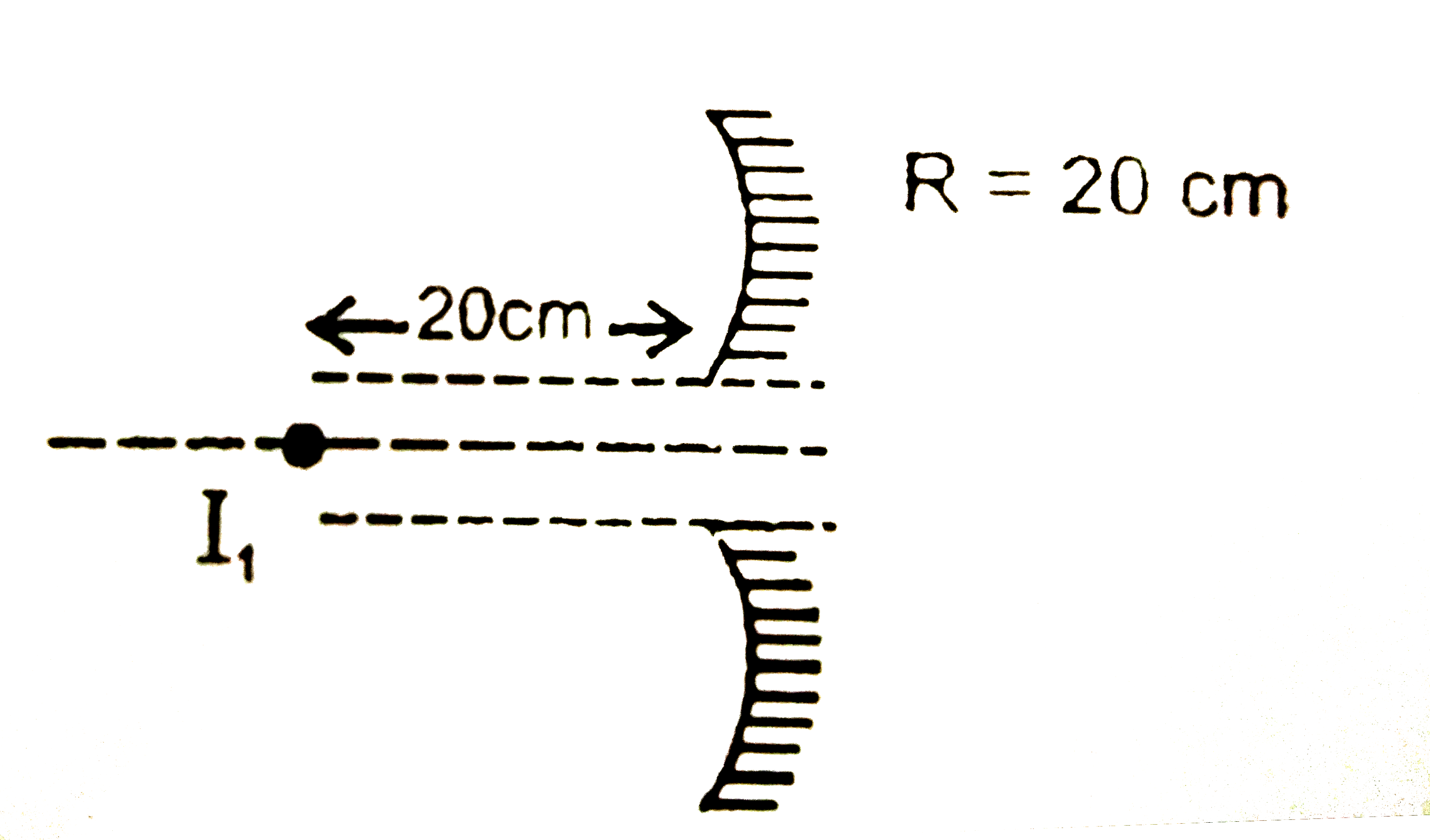 As the object for the mirrors is at `20 cm` so the image will be at `20 cm` only `therefore u=-2f` ALSO. `rArr` magnifiction `=m=(y_(1))/(y_(0))=(-v)/(u)` `rArr (y_(1))/(-(1mm))=^(-)((-20)/(-20)) rArr y_(1)=+(1 mm)` so the final images are like. 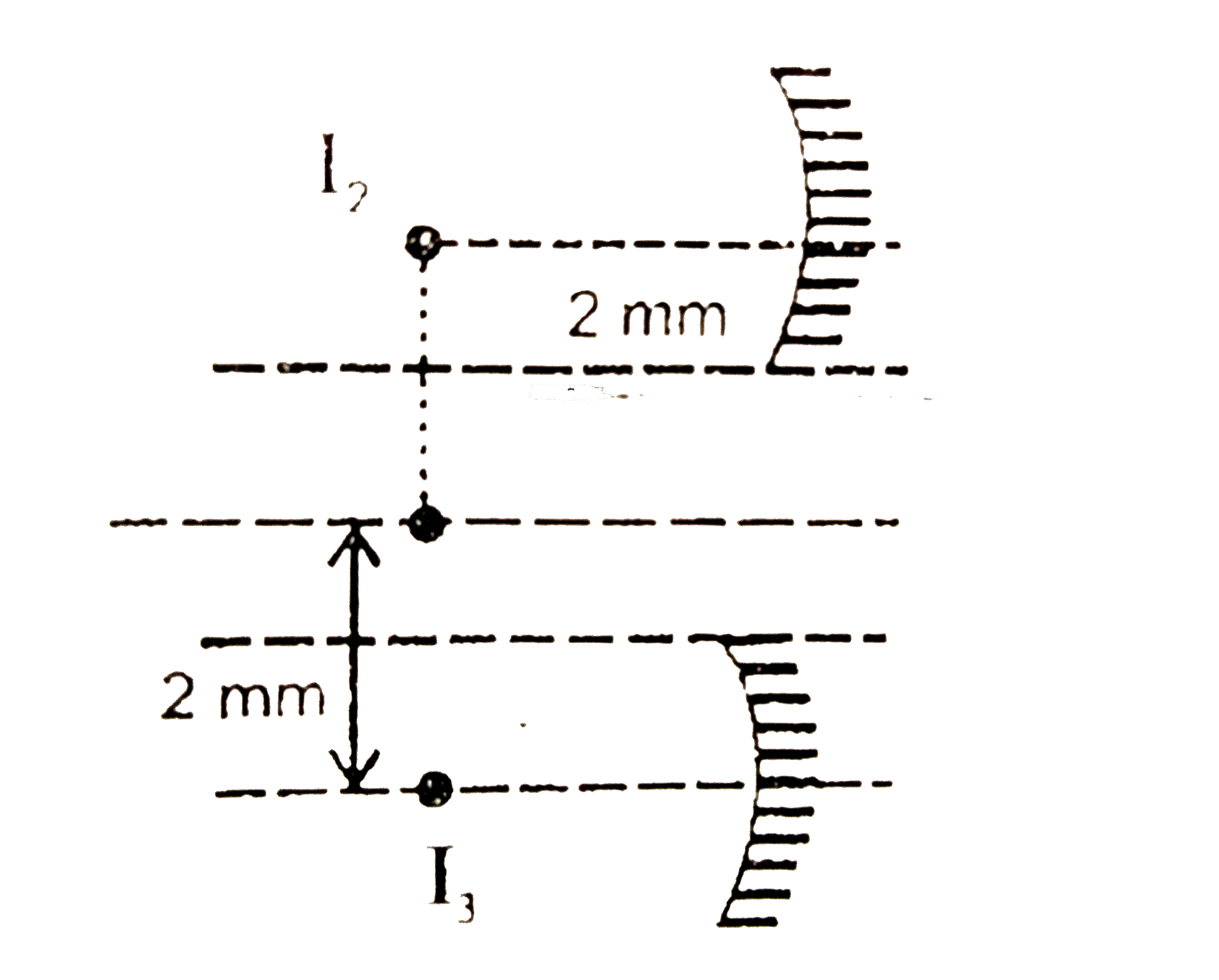 so the distance between the images is `4 mm`. (c) Now, these `I_(2) and I_(4)` BEHAVE as the `2` sources for fringe pattern. `rArr beta=(lambdaD)/(d)=(vD)/(fd) =((c//mu)D)/(fd)` `=((3xx10^(8))/((4)/(3)))xx(0.8)/((3)/(3)xx10^(15)xx(4xx10^(3))) =60 mum`. |
|