

Saved Bookmarks
| 1. |
An inductor and two capacitors are connected in the circuit as show in Fig Initially capacitor A has no charge and capacitor B has CV charge. Assume that the circuit has no resistance at all. At t = 0, switch S is closed, then [given LC = (2)/(pi^(2) xx 10^(4)) S^(2) and Cv = 100 mC] |
|
Answer» when current in the circuit is maximum, charge on each capacitor is same 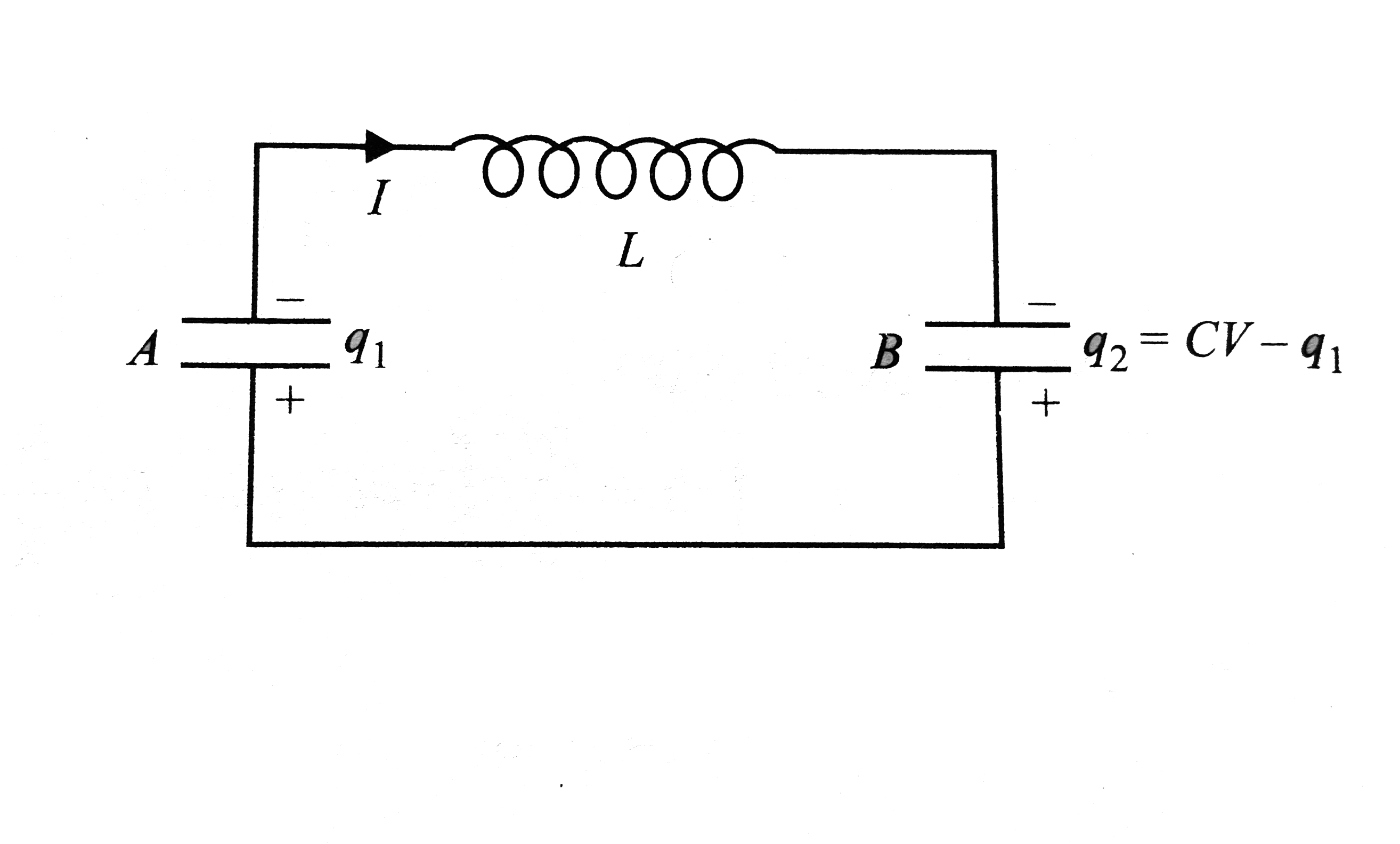 `I = (dq_(1))/(dt)` Applying kirchoff's law, `(CV - q_(1))/(C ) - (q_(1))/(C ) - L(dI)/(dt) = 0 rArr (CV - 2q_(1))/(LC) = L (d^(2)q_(1))/(dt^(2))` `rArr (d^(2)q_(1))/(dt^(2)) = - (2)/(LC) (q_(1) - (CV)/(2))` `rArr q_(1) - (CV)/(2) = A SIN (omega t + delta)` (i) where `omega = SQRT((2)/(LC)) = 100 pi rad//s` At `t = 0`, `q_(1) = 0 rArr 0 - (CV)/(2) = A sin delta` (ii) Differentiating (i), `(dq_(1))/(dt) - 0 = A omega cos (omega t + delta)` `rArr I = A omega cos (omega t + delta)` At `t = 0, I = 0 rArr 0 = A omega cos delta rArr delta = (pi)/(2)` From (ii), `A = - (CV)/(2)` From (i), `q_(1) = (CV)/(2) - (CV)/(2) sin (omega t + (pi)/(2))` (iv) `rArr q_(1) = (CV)/(2) (1 cos 100 pi t) mC` Now `q_(2) = CV - q_(1) = (CV)/(2) (1 + cos omega t)` (v) `= 50 (1 + cos omega pi t)` From (ii), `I = - A omega sin omega t` Current in the circuit is maximum for `omega t = (pi)/(2)*` And for `omegat = (pi)/(2)`, we SEE from (iv) and (v) that `q_(1) = q_(2) = (CV)/(2)` |
|