

Saved Bookmarks
| 1. |
An initially empty beaker, in the shape of a cylinder with cross sectional area A, is left out in th rain. The raindrops hit the beaker vertically downward with speed v. The rain continues at a constant rate, so the height of the water in the beaker h(t) increases with time t at a rate dh/dt=u, where u is small compared to v. The raindrops quickly come to rest inside the beaker, so we can neglect any kinetic energy of the water that has collected in the beaker. Let p denote the density of water (i.e., the mass per unit volume) If the beaker is placed on a weighing scale, while the beaker is wstill in the rain, the impact of the raindrops on the beaker will cause the reading on the scaleincreased by the impact of the raindrops ? (Neglect the effect of raindrops that hit the scale directily). |
|
Answer» `(pAv^(2))/(g)` m=pAh When the height changes at a rate dh/dt=w, the mass changes at the rate `(dm)/(dt)=pA(dh)/(dt)=pAu` (b) The height of the center of mass of the water in the beaker is at `y_(cm)` h/2 (at least if we ASSUME incompressible fund, i.e. a constant density, which is a very good approx imation for water). The rate at which the height of the center of mass increases is `(dy_(cm))/(dt)=(1)/(2) (dh)/(dt)=(w)/(2)` (c) The center of mass is moving upward because more water is added to the beaker.i.e. as time evolves we are talking about a whole sequence of PHYSICAL systems, not about the center of mass of a fixed given system. At any given time, the water in the beaker is at rest and hence its momentum vanishes. It is therefore incorrect to conclude that the water in the beaker has a total vertical momentum. (d) The raindrops enter the beaker with a speed v and then quickly come to rest inside the beaker. Consider a short time interval `Deltat`, and consider the system that consists of the beaker, all the water that has landed in the beaker by the beginning of the time intergval, plus the water that will come to rest inside the beaker during the time interval. During the time interval `Deltat`the height of the water in the beaker will increase by `Deltah=wDeltat`, so the volume of water that will come to rest during the time interval is `DeltaV=Adeltah=AwDeltat`, shown shaded in the diagram on the right. The mass of this water is `DeltaM=pDeltaV=pAwDeltat`. Taking the vertical direction as the y-direction, the momentum of this water at the beginning of the interval is `vecP_(i)` `=[0,-vDeltaM,0]=[0,-pAwvDeltat,0]`. The final momentum is zero, after the raindrops come rest, so `vecF_(ext)=(DeltavecP)/(Deltat)=(-vecP_(i))/(Deltat)=[0,pAw,0]` 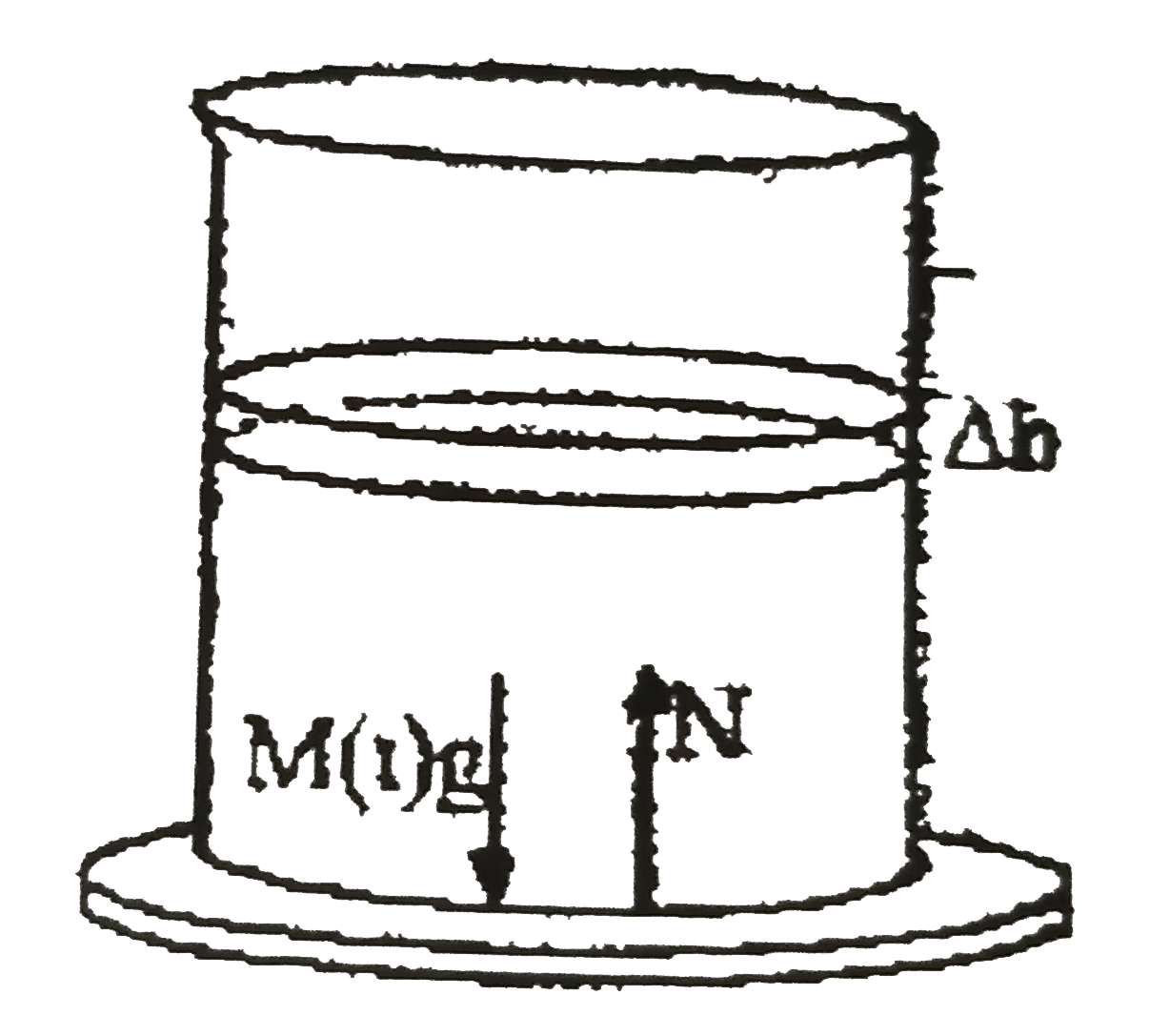 From the diagram one can see that `F_(ext)=N` M(t)g, where M(t) is the total mass of the beaker and the water in it at time t.So, N=M(t)g+pAwv By Newton's third law the beaker exerts a force of EQUAL magnitude on the scale, which detemines its reading the first term is just the weight of the system, while the question asks by how much the reading is increased by the impact of the raindrops. Thus the second term in the above expression is the answer to the question. `DeltaN=pAwv` Since, scales often read in units of mass rather than force, it would be equally CORRECT to say that the mass reading would be increased by `DeltaM=pAwv//g` |
|