

Saved Bookmarks
| 1. |
Apparent distance of the image formed by a concave mirror dipped in water Find the location of the final image of O formed by the system (Fig. 34-8). Assume that O is on the principal axis of the concave mirror. |
|
Answer» Solution :(1) Here, the image is formed after three events : refraction from water, reflection from mirror, and again refraction from water. (2) As we discussed in Chapter 33, image of one event will act as an object for the next event. Thus, first event we consider is refraction from water for which we can apply fromula for APPARENT depth. Then next event will be reflection from concave mirror. The next event would be again refraction from water surface which will be the last event. Calculation : when the mirror sees the object O, it does not appear to be at 10cm from the water surface. Rather, its apparent distance is `(d_(app))/(n_("reflected"))=(d_(act))/(n_("incident"))` `d_(app)=10xx(4)/(3)=(40)/(3)cm` from water surface The image formed by this refraction will act as an object for the next surface (mirror) : `u=-((40)/(3)+(5)/(3))=-15cm` Note that focal length of mirror (r/2) does not depend on the refractive INDEX of SURROUNDING medium. The image distance is given by `v=(uf)/(u-f)=(-15xx-10)/(-15-10)=-30cm` These reflected rays will not actually be able to meet at 30cm in FRONT of the mirror. However, this image will act as an object for the next event : refraction from the water surface. For this event, we have to MEASURE distance of the object from the water surface : `(d_("app"))/(n_("refracted"))=(d_("act"))/(n_("incident"))` In this event, the rays are incident from water and refracted into air : `(d_(app))/(1)=((85)/(3))/((4)/(3))` `d_(app)=(85)/(4)cm` from water surface. 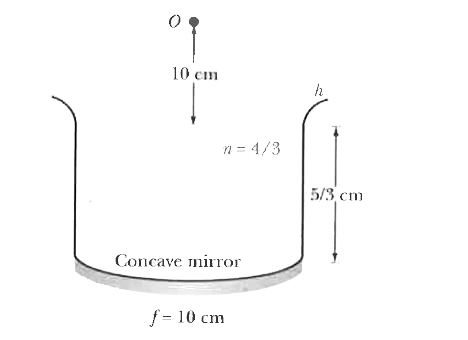 Forming an image of object O by a concave mirror dipped on water. |
|