

Saved Bookmarks
| 1. |
Arrive at Snell's law of refraction, using Huygen's principle for refraction of a plane wave. |
Answer» Solution :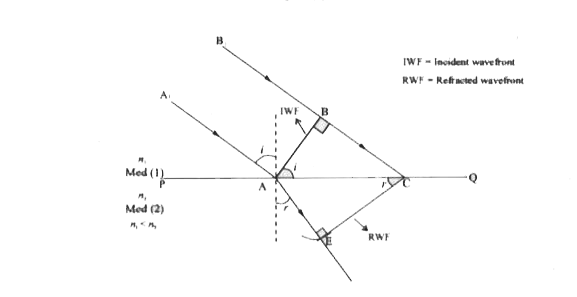 Distance AE=`v_2 TAU , tau` - time taken for opticalpath Distance BC = `v_1tau, i_1` - angle of incidencein medium (1) From the right angled `triangleABC` , sin I = `(BC)/(AC)` and from the right angled `triangleAEC` , sin R =`(AE)/(AC)` Hence, `(sin i)/(sin r)=(BC)/(AE)=(v_i tau)/(v_2 tau)` or `(sin i)/(sin r) =v_1/v_2` ....(1) By definition , absolute R.I of a mediumw.r.t air/vacuum=n=`c/v` for medium (1) = `n_1=c/v_1` for medium (2)=`n_2=c/v_2` So that , `v_1/v_2=n_2/n_1` ...(2) Using (2) in (1) we get `(sin i)/(sin r)=n_2/n_1` where , `n_2 > n_1`. or `n_1 sin i=n_2=sin r` ...(3) i.e., R.I. of medium(1) timessine of angle in the medium (1)=R.I of medium (2) times sine of anglein the medium 2. This expression (3) is known as the Snell.s law . The ratio `n_2/n_1` can be WRITTEN as `n_2` (R.I. of medium (2) w.r.t medium (1) . Note: From (1), `n_2=(sin i_1)/(sin i_2)=v_1/v_2=lambda_1/lambda_2` i.e., `v_1sin i_2=v_2sin i_1, lambda_2sini_1 =lambda_1 sin i_2` and `n_1 sin i_1 = n_2 sin i_2` |
|