

Saved Bookmarks
| 1. |
Arrive at the expressionfor theimpedanceof a seriesLCR circuitusingphasordiagrammethodand hence writethe expressionfor the currentthroughthe circuit . |
|
Answer» Solution :consider a resistance R, an INDUCTOR of self-inductanceL anda capacitor of capacitanceC connectedin seriesacross an AC source. The appliedvoltageis given by , `v=v_0 sin omegat` …(1) 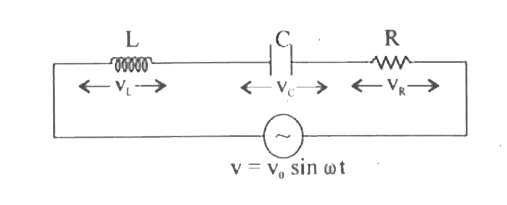 where, v is the instantaneousvalue, `v_0` is the peak VALUE and `omega =2pif` , F being the frequencyof AC. If i be theinstantaneous current at time t, theinstantaneousvotages across R,L and C arerespectivelyiR, `iX_L` and `iX_C`. The vectorsum of the voltageamplitudesacrossR,L , C equalsthe amplitude`v_0`of the voltage applied. Let `V_R, V_L` and `V_C` be the voltageamplitudes acrossR, L and C respectivelyand `I_0` the currentamplitude . Then `V_R=i_0R` is in phasewith `i_0` . `V_L=i_0X_L=i_0(omegaL)` LEADS `i_0` by `90^@` . `v_C=i_0X_C=i_0(1/(omegaC))` lags behind `i_0` by `90^@`. The currentin a pureresistoris PHASE with the voltage, whereas the current in a pure inductorlags thevoltage by `pi/2` rad. The currentin a purecapacitorleads the voltageby `pi/2`rad. For `V_L > V_C` , phaseangle `phi` betweenthe voltageand thecurrentis positive. From theright angled triangle OAP, 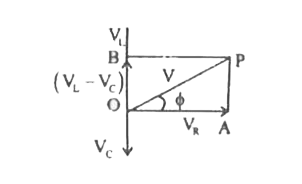 `OP^2=OA^2+AP^2=OA^2+OB^2 ( because AP=OB)` `V^2=V_R^2 +(V_L-V_C)^2 =(iR)^2 +(iX_L-iX_C)^2` `=i^2(R^2 + (X_L-X_C)^2)` `i=V/sqrt(R^2 +(X_L -X_C)^2)=V/Z` and `Z=sqrt(R^2+X_L-X_C)^2` Where Z is the impedanceof the circuit . Phase angle between v & i. tan `phi=(V_L-V_C)/V_R=(X_L-X_C)/R_L` ,`phi=tan^(-1)((X_L-X_C)/R)` |
|