

Saved Bookmarks
| 1. |
At points P and Q, two identical charges each q are placed. When we move from P to Q (oa - the line joining them), electrostatic potential |
|
Answer» goes on decreasing 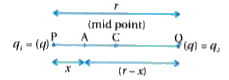 Above figure shows the situation as per the statement. Consider a point A on the line segment `bar(PQ)` , at distance x from point P. Total electric potential at point A is, `V= V1 +V_(2)` `= (kq)/(x) +(kq)/(r-x)` `:. V= kq((1)/(x)+(1)/(r-x))` `:. (dV)/(dx)=kq[(-(1)/(x^(2)))-(1)/((r-x)^(2))(-1)]` `:. (dV)/(dx)=kq [(1)/((r-x)^(2))-(1)/(x^(2))]` Now taking `(dV)/(dx) =0` we get `0 =kq[(1)/((r-x)^(2))-(1)/(x^(2))]` `:. (1)/(r-x)^(2)=(1)/(x^(2))` `:. x^(2)=(r-x)^(2)` `:. x^(2)=r^(2)-2xr+x^(2)` `:. 2xr = r^(2)` `:. x =(r)/(2)` `implies "At" x = (r)/(2) V ` = max . OR V = min. Now `(d^(2)V)/(dx^(2))=(d)/(dx)((dV)/(dx))` `:. (d^(2)V)/(dx^(2))= (d)/(dx) [kq{(1)/((r-x)^(2))-(1)/(x^(2))}]` `=kq[-(2)/((r-x)^(3))(0-1)-(-(2)/(x^(3)))]` `:. (d^(2)V)/(dx^(2))=2kq[(1)/((r-x)^(3))+(1)/(x^(3))]` Now placing x = `(r)/(2)`in above equation `((d^(2)V)/(dx^(2)))_("at" x=(r)/(2))=2kq[(8)/(r^(3))+(8)/(r^(3))]` `= (32kq)/(r^(3))` `GT0` `implies "At" x = (r)/(2)` value of V is minimum. THUS, as we move from P to C, potential goes on decreasing initially, then potential becomes minimum at mid point C and then potential goes on increasing. |
|