

Saved Bookmarks
| 1. |
At the moment t =0 , a force F = kt ( k is a constant) is applied to a small body of mass m resting on a smooth horizontal plane.The permanent direction of force F , makes an anglebeta with the horizontal . Calculate i) The velocity of the body at the moment of its breaking off the plane . ii) The distance traversed by the body upto this moment |
|
Answer» SOLUTION :The free body diagram of mass m is shown in figure . For vertical equilibrium ` F sin beta + N = mg ( or ) As F = KT ` `:. ktsin beta + N = mg `........... (1) 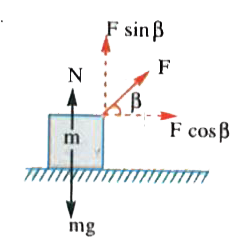 Equation of motion of mass m is `F cos beta = ma` ` or kt cos beta = m (dv)/(dt) ( as " "a=(dv)/(dt)), dv=(kt)/(m) cos beta dt ` Integrating ` int_0^(v) dv = (k)/(m) cos betaint_0^(t) dt ` `[v]_0^(v) = (k)/(m) cos beta [(t^(2))/(2)]_0^(t) implies v= (k cos beta )/( 2 m ) t^(2)` ........... (2) At the moment of breaking off the PLANE N =0 . If ` tau` is the corresponding time , then ` :.` From (1) `k tau sin beta = mg or tau = (mg)/(k sin beta ) `........... (3) `:.` The velocity at the moment of breaking off the plane is given by putting ` t= tau ` in equation ( 2) , so `(v=v_0)` ` v_0 = (k cos beta )/( 2 m) tau^(2) = ( k cos beta )/(2 m) ((mg)/(k sin beta ))^(2)` `:. v_0=(mg^(2) cos beta)/( 2 k sin^(2) beta)` (b) Equation (2) may be expressed as ` (dx)/(dt) = (k cos beta )/(2m ) t^(2)` Integrating `[x]_0^(x)=(k cos beta)/( 2m) [(t^3)/(3)]_0^(t)` `:. x = (k cos beta )/( 6 m) t^(3)` When the body breaks off the plane , we have ` :. x_0=(k cos beta )/( 6m) ((mg)/( k sin beta ))^(3) = (m^(2)g^(3) cos beta)/( 6k^(2) sin^(3) beta )` |
|