

Saved Bookmarks
| 1. |
Calculate potential energy of a point charge - q placed along the axis due to a charge + Q uniformly distributed along a ring of radius-, R. Sketch P .F. as a function or axial distance z from the centre of the ring. Looking at graph, can you see what would happen if - q is displaced slightly from the centre of the ring (along the axis) ? |
|
Answer» Solution :Let us consider a ring of radius R = a having charge Q distributed uniformly over the ring. Also a point P at a distance z on its axis passing through centre. Take r is the distance of P from charge dq on the ring. 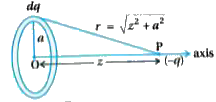 `r= sqrt(z^(2)+a^(2))` where a=R `:.` Electric potential at point P, `V= int(KDQ)/(r) = kint(dq)/(r)=kint(dq)/(sqrt(z^(2)+a^(2)))` `:. V= (k)/(sqrt(z^(2)+a^(2)))intdq= (kQ)/(sqrt(z^(2)+a^(2)))[ because int dq = Q]` If - q is at P then potential energy U = W ` = q xxV` ` = -q xx(kQ)/(sqrt(z^(2)+a^(2)))` `U=-(kQq)/(a[sqrt((z^(2))/(a^(2))+1)])` Now `(kQq)/(a) =S` supposing NEW CONSTANT `U=-(S)/((1+(z^(3))/(a^(2)))^(1//2))` `z gt gt gt a `then `(z^(2))/(a^(2)) gt 1` but `z=0 , (z^(2))/(a^(2))=0` `:. U =-S` The graph of `U rarr` Zis shown below , 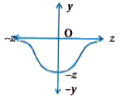 If charge is displaced, it WOULD PERFORM S.H.M. But from the graph, we cannot predict the type of oscillations. |
|