

Saved Bookmarks
| 1. |
Calculate potential on the axis of a disc of radius R due to a charge Q uniformly distributed on its surface. |
|
Answer» <P> Solution :Let us consider a point P on the axis of the disc at a distance x from the centre of the disc. Let the disc is divided into a numerous CHARGED rings as shown in figure.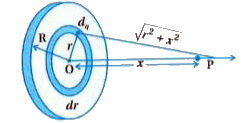 Let radius of ring r width dr and charges DQ `:. Sigma dA = sigma2 pi rdr ` Potential at P `dV = (kdq)/(r)` charge on the ring dq = `+sigma [ pi (r+dr)^(2)-pir^(2)]` `:. dq = +sigma pi [ (r+dr)^(2)-r^(2)]` `= +sigma pi [ r^(2)+2rdr +dr^(2)-r^(2)]` `= +sigma pi [ 2 rdr +dr^(2)]` Neglecting `dr^(2)` as dr is very small dq = `2 pi r sigma dr ` and dV = `(kdq)/(sqrt(r^(2)+x^(2)))` `= (kxx2pir sigmadr)/(sqrt(r^(2)+x^(2)))` [From equation (2)] `:. V = 2 pi k sigma int _(0)^(R) (rdr)/(sqrt(r^(2)+x^(2)))=2piksigmaint_(0)^(R)( r^(2)+x^(2))(-1//2)rdr` `:. V= 2PI ksigma[(r^(2)+x^(2))^(1//2)-x]_(0)^(R)` `:. V = (2pi sigma)/(4 pi in_(0))[(R^(2)+x^(2))^(1//2)-x]` `:. V = (2pixxQ)/(4pi in_(0)xxpi R^(2))[sqrt((R^(2)+x^(2))^(1//2))-x]` `:. V =(2Q)/(4pi inn_(0)R^(2))[sqrt((R^(2)+x^(2))^(1//2))-x]` |
|