

Saved Bookmarks
| 1. |
Calculate the angle of emergence (e) of the ray of light incident normally on the face AC of a glass prism ABC of refractive index sqrt(3). How will the angle of emergence change qualitatively, if the ray of light emerges from the prism into a liquid of refractive index 1.3 instead of air ? |
|
Answer» Solution :As shown in the diagram, the angle of incidence Zi at the face AB of glass prism ABC is `30^(@)` and refractive index of glass prismn =` sqrt(3)` . If `anglee` be the angle of emergence in AIR medium then as per snell.s law: `(sin i)/(sin e) = n_(ag) = (1)/(n_(gn))implies ( sin 30^(@))/(sin e) = (1)/(sqrt(3))` `implies sin e = sqrt(3) XX sin 30^(@) = (sqrt(3))/(2) implies e= sin^(-1) ((sqrt(3))/(2))= 60^(@)` 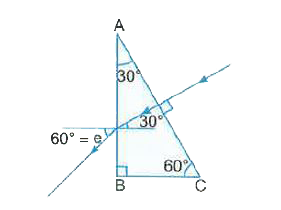 If the prism is immersed in a liquid of refractive index `n_(g), = 1.3`, then new angle of emergence e will be given by : `(sin i)/(sin e) = (1)/(n_(g)) or sin e= n_(gl)xx sin I = (sqrt(3))/(1.3) xx sin 30^(@)` `implies sin e = (sqrt(3))/(1.3) xx(1)/(2) = (1)/(1.3) ((sqrt(3))/(2))` Obviously sin e. `LT`sin e and HENCE e. `lt` e. So the angle of emergence decreases when the prism is immersed in the liquid. |
|