

Saved Bookmarks
| 1. |
Calculate the electric field due to a dipole on its axial line and equatorial plane. |
Answer» Solution :Case (i) ELECTRIC field due to an electric dipole at points on the axial line . Consider an electric dipole placed on the x-ax is as shown in figure . A point Cis located at a distancefo r from the midpoint O of the dipole along the axial line . The electric field at a point C due to + q is 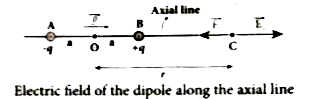 `vecE=(1)/(4piepsilon_(0))(q)/((r-a)^(2))` along BC Since the electric dipole mometn vector `vecp` is from -q is from -q to +q and is drected along BC the above equation is rewritten as `vecE_(+) =(1)/(4piepsilon_(0))(q)/((r-a)^(2)) hatp` where `hatp` is the electric dipole moment unit vector from -q to +q . The electric field at a point C due to -q is `vecE_(-)=-(1)/(4piepsilon_(0))(q)/((r+a)^(2)) hatp` Since +q is located closer to the point C than -q , `vecE_(-).vecE_(+)` us stronger than `vecE` . Therefore the length of the `vecE_(+)` vector is drawn large than that of `vecE_(-)` vector . The total electric field at point C is calculate using the superposition principle of the electric field . `vecE_("tot")=vecE_(+)vecE_(-)` `=(1)/(4piepsilon_(0))(q)/((r-a)^(2))hatp-(1)/(4piepsilon_(0))(q)/((r-a)^(2))hatp implies vecE_("tot")=(1)/(4piepsilon_(0))((1)/((r-a)^(2))-(1)/((r-a)^(2)))hatp` `vecE_("tot")=(1)/(4piepsilon_(0))q((4ra)/((r^(2)-a^(2))^(2)))hatp` Note that the total electric field is along `vecE_(+)` since +q is closer to C than -q . 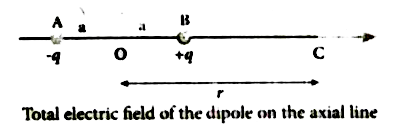 The direction of `vecE_("tot")` is shown in Figure If the point C is very far AWAY from the dipole then `(r gtgt a)` . Under this LIMIT the term `(r^(2)-a^(2))^(2)z r^(4)` . Substituting this into equation we GET `vecE_("tot")=(1)/(4piepsilon_(0))((4aq)/(r^(3)))hatP ( r gt gt a) ` since 2 aq `hatp=vecp` `vecE_("tot")=(1)/(4piepsilon_(0))(2vecp)/(r^(3)) "" (r gt gt a)` If the point C is chosen on the left side of the dipole the total electric field is still in the direction of `vecp` . Case (ii) Electric field due to an electric dipole at a point on the equatorial plane Consider a point C at a distance r from the midpoint O of the dipole on the equatorial plane as shown in Figure. Since the point C is equi -distant from +q and -q the magnitude of the electric fields of +q and -q are the same . The direction of `vecE_(+)` is along BC and the direction of `vecE_(-)` is along CA. `vecE_(+) ` and `vecE_(-)` are resolved into two components one component parallel to the dipole axis and the other perpendicular to it . The perpendicular components `|vecE_(+)| sin theta` and `|vec_(-)|sintheta` are oppositely directed and cancel each other . The magnitude of the total electric field at point C is the sum of the parallel components of `vecE_(+)`and `vecE_(-)` and its direction is along `-hatP` `vecE_("tot")=-|vecE_(+)|costheta hatp-|vecE_(-)|costhetahatp "" cdots(1)"" cdots(1) ` The magnitudes `vecE_(+)` and `vecE_(-)` are the same and are given by `|vecE_(+)|=|vecE_(-)|=(1)/(4piepsilon_(0))(q)/((r^(2)+a^(2))) ""cdots (2)` By substituting equation (1) into equation (2) we get `vecE_("tot")=-(1)/(4piepsilon_(0))(2qcos theta)/((r^(2)+a^(2)))hatp=-(1)/(4piepsilon_(0))(2qa)/((r^(2)+a^(2))^((3)/(2)))hatP"" "since cos " theta (q)/(sqrt(r^(2)+a^(2)))` At very large DISTANCES `(r gtgta )` the equation becomes `vecE_("tot")=-(1)/(4piepsilon_(0))(P)/(r^(3))( r gtgta)` 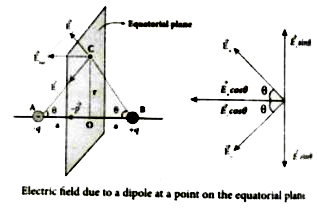
|
|