

Saved Bookmarks
| 1. |
Calculate the electric field due to a dipole on its equatorial plane.(OR) Electric field due to an electric dipole at a point on the equatorial plane |
|
Answer» Solution :Consider a point C at a distance r from the midpoint O of the dipole EQUATORIAL plane on as shown in Figure. Since the point C is equidistant from `+q` and `-q` the MAGNITUDE of the electric fields of `+q` and `-q`are the same. The direction of `vecE(+)`is along BC and the direction of `vecE_(-)` is alongCA. `vecE_(+)` and `vec_(-)` are resolved into twocomponents, one component parallel to the dipole axis and the other perpendicular to it. The perpendicular components of `|vecE_(+)| sin theta`and `vecE_(-)sin theta` are oppositely directed and cancel each other. The magnitude of the total electric field at point C is the sum of the parallel components of `vecE_(+)` and `vecE_(-)` and its direction is along `hatp` `vecE_(tot)=-|E_(+)|costhetahatp-|vecE_(-)|costhetahatp`ldots(1) The MAGNITUDES `vecE_(+)`and `vecE_(-)` are the same and are given by `|vecE_(+)|=|vecE_(-)|=(1)/(4piepsilon_(0))(q)/((r^(2)+a^(2)))ldots(2)`By substituting equation (1) into equation (2), we get `vecE_(tot)=-(1)/(4piepsilon_(0))(2qcostheta)/((r^(2)+a^(2)))hatp=(1)/(4piepsilon_(0))(2qa)/(r^(2)+a^(2))^((3)/(2))hatp` `sinncos=(a)/(sqrt(r^(2)+a^(2))` `vecE_(tot)=-(1)/(4piepsilon_(0))(vecp)/((r^(2)+a^(2))^((3)/(2)))` `sincevecp=2qahatpldots(3)`, At very large distances `(r gt gt a)`, the equation becomes`vec_(tot)=-(1)/(4piepsilon_(0)r^(3)(rgt gta)` 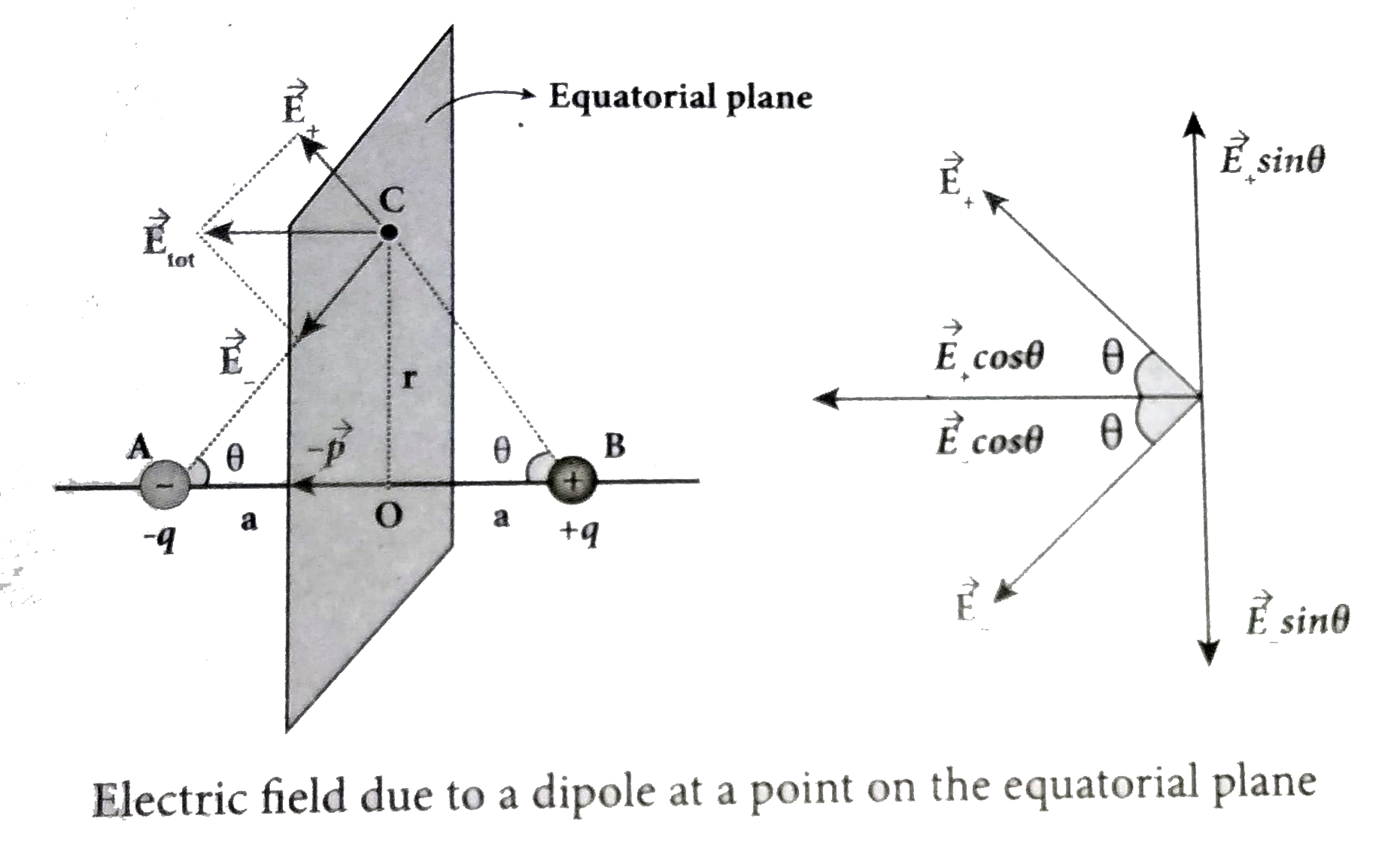
|
|