

Saved Bookmarks
| 1. |
Calculate the electrostatic force and gravitational force between the protos and the electron in a hydrogen atom. They are separated by a distance of 5.3xx10^(11) m. The magnitude of charges on the electron and proton are 1.6xx10^(-19) C.M Mass of the electrons is m_(e)=9.1xx10^(-31) kg and mass of proton is m_(p)=1.6xx10^(-27) kg . |
|
Answer» <P> Solution :The proton and the electron attract other . The magnitude of the electrostatic force between these two particles is given by`F_(e)=(ke^(2))/(r^(2))=(9xx10^(9)xx(1.6xx10-19)^(2))/((5.3xx10^(-11))^(2))=(9xx2.56)/(28.09)xx10^(-7)=8.2xx10^(-8)`N The gravitational force between the proton and the electron is ATTRACTIVE . The magnitude of the gravitational these particles is `F_(G)=(Gm_(e)m_(p))/(r^(2))=(6.67xx10^(-11)xx9.1xx10^(-31)xx1.6xx10^(-27))/((5.3xx10^(-11))^(2))=(97.11)/(28.09)xx10^(-47)=3.4xx10^(-47)N` The ratio of the two forces `(F_(e))/(F_(G)) =(8.2xx10^(-8))/(3.4xx10^(-47))=2.41xx10^(39)` Note that `F_(e)~~10^(39)F_(G)` The electrostatic force between a proton and an electron is enormously greater than the gravitational force between them. Thus the gravitational force is negligible when compared with the electrostatic force in many situations such as for small size objects and in the atomic domain . This is the reason why a charged comb attracts an uncharged piece of paper with greater force even though the piece of paper is attracted DOWNWARD by the Earth . 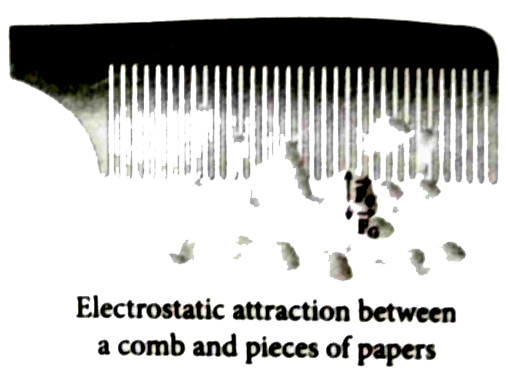
|
|