

Saved Bookmarks
| 1. |
Calculate the electrostatic potential energy of a system of three point charges q_(1) , q_2 and q_(3) located respectively at vecr_(1) , vecr_(2) and vecr_(3) with respect to a common origin O. |
|
Answer» Solution :Consider a system of three point charges `q_1 , q_2` and `q_3` as shown in Fig. The potential energy of a system of point charges is equal to work done in building up this configuration of charges . To bring `q_1` first from infinity to its present position no work is done because there is no FORCE i.e., `W_(1) = 0` . To bring `q_(2)` frominfinity to its present position work is to be done against the electric FIELD of charge `q_1` . By DEFINITION this work done is `W_(2) = q_(2) . V (vecr_(2)) = q_(2) . (1)/(4pi in_(0)) , (q_(1))/(r_(12)) = (1)/(4 pi in_(0)) * (q_(1) q_(2))/(r_(12))` Now to bring `q_(3)` from infinity to its present position work is to be done against the combined electric fields of `q_1` and `q_2` . Thus , `W_(3) = q_(3) [V_(1) (vecr_(3)) + V_(2) (vecr_(3)) ] = q_(3) [ (1)/(4pi in_(0)) * (q_(1))/(r_(13)) + (1)/(4pi in_(0)) * (q_(2))/(r_(23))] = (1)/(4pi in_(0)) [* (q_(1) q_(3))/(r_(13)) + + (q_(2) q_(3))/(r_(23))]` Thus , total work done in building up the charge configuration `W = W_(1) + W_(2) + W_(3) = (1)/(4 pi in_(0)) [ (q_(1) q_(2))/(r_(12)) + (q_(1) q_(3))/(r_(13)) + (q_(2) q_(3))/(r_(23))]` `therefore` Electrostatic potential energy of the given configuration `U = (1)/(4pi in_0) [ (q_(1) q_(2))/(r_(12)) + (q_(1) q_(3))/(r_(13)) + (q_(2) q_(3))/(r_(23))]`. 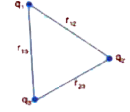
|
|