

Saved Bookmarks
| 1. |
Calculate the resultant capacitances for each of the following combinations of capacitors . |
Answer» Solution :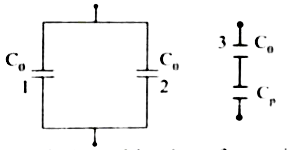 Parallel COMBINATION of capacitor 1 and 2 `C_(p)= C_(0)+C_(0)=2C_(0)` Series combination of capacitor `C_(p)` and 3 `(1)/(C_(s))=(1)/(C_(p))+(1)/(C_(3))=(1)/(2C_(0))+(1)/(C_(0))" (or)" (1)/(C_(s))=(3)/(2)C_(0)" " "(or)" " "C_(s)=(2)/(3) C_(0)` (b) 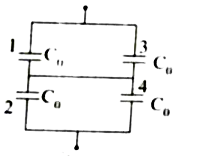 Capacitor 1 and 2 are series combination `(1)/(C_(s_(1)))=(1)/(C_(1))+(1)/(C_(2))=(1)/(C_(0))+(1)/(C_(0))=(1)/(C_(0))" (or)" (1)/(C_(s_(1)))=(2)/(C_(0))"(or)" C_(s_(1))=(C_(0))/(2)` Similarly 3 and 4 are series combination `(1)/(C_(s_(1)))=(1)/(C_(3))+(1)/(C_(4))+(1)/(C_(0))+(1)/(C_(0))=(2)/(C_(0)) "(or)" C_(s_(2))=(C_(0))/(2)` `C_(s_(1)) ` and `C_(s_(2))` are in parallel combination 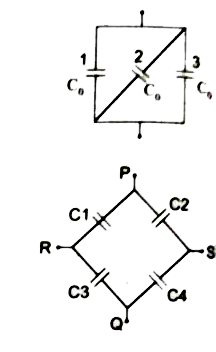 `C_(P)= C_(s_(1))+C_(s_(2))=(C_(0))/(2)+(C_(0))/(2) "(or)" C_(P)= (2C_(0))/(2) "" C_(P)=C_(0)` (c ) Capacitor 1,2 and 3 are in parallel combination `C_(P)=C_(0)+C_(0)+C_(0)=3C_(0)` `C_(P)=3C_(0)` (d) Capacitar `C_(1)` and `C_(2)` are in combination `(1)/(C_(s_(1)))=(C_(1)+C_(2))/(C_(1)C_(2))` `C_(s_(1))= (C_(1)C_(2))/(C_(1)+C_(2))` 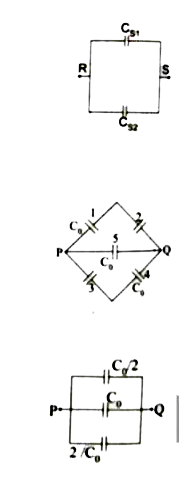 Similarly `C_(3)` and `C_(4)` are in series combination `(1)/(C_(s_(2)))=(1)/(C_(3))+(1)/(C_(4))=(C_(3)+C_(4))/(C_(3)C_(4))` `C_(s_(2))= (C_(3)C_(4))/(C_(3)+C_(4))` `C_(s_(1)) ` and `C_(s_(2))` are in parallel combination ACROSS R.S: `CP = C_(s_(1))+ C_(s_(2))` `=(C_(1)C_(2))/(C_(1)+C_(2))+(C_(3)C_(4))/(C_(3)+C_(4))=(C_(1)C_(2)(C_(3)+C_(4))+C_(3)C_(4)(C_(1)+C_(2)))/((C_(1)+C_(2))(C_(3)+C_(4)))` `C_(P)=(C_(1)C_(2)C_(3)+C_(1)C_(2)C_(4)+C_(3)C_(4)C_(1)+C_(3)C_(4)C_(2))/((C_(1)+C_(2))(C_(3)+C_(4)))` (e) Capacitor 1 and 2 are series combination `(1)/(C_(s_(1)))=(1)/(C_(1))+(1)/(C_(2))=(1)/(C_(0))+(1)/(C_(0))=(1)/(C_(0))` `(1)/(C_(s_(1)))=(2)/(C_(0)) "(or)" C_(s_(1)) = (C_(0))/(2)` Similarly 3 and 4 are series combination `(1)/(C_(s_(2))=(2)/(C_(0)) "(or)" C_(s_(2))= (C_(0))/(2)` Three CAPACITORS are in parallel combination |
|