

Saved Bookmarks
| 1. |
Compound (A), C_(8)H_(6)NOBr, is optically active. Reduction of (A) gives (B) which reacts with nitrouos acid to form (C), dihydric alcohol. Benzene sulphonyl chloride reacts with (B) to give a product soluble in NaOH. Hydrolysis of (A) gives (D) which is an optically active acid. (A) does not give any precipitate with aqueous AgNO_(3) . Controlled oxidation of (A) gives monobromo benzoic acid. Compound (A) on reaction with Br_(2)//Fe gives only one compound. Identify (A), (B), (C), and (D). |
|
Answer» <P> Solution :i.DU in A = `((2n_(C) + 2) - (n_(H)+n_(X) - n_(N))/(2)``= ((8xx2+2) - (6+1-1))/(2)` `= 6^(@)` ii. SIX DU and `(C:H~~1:1)` suggest a benzene ring (4 DU) and 2 DU (for `C-=N`) group, since (A) on HYDROLYSIS gives acid. iii. Reactions can be summarised as follows: 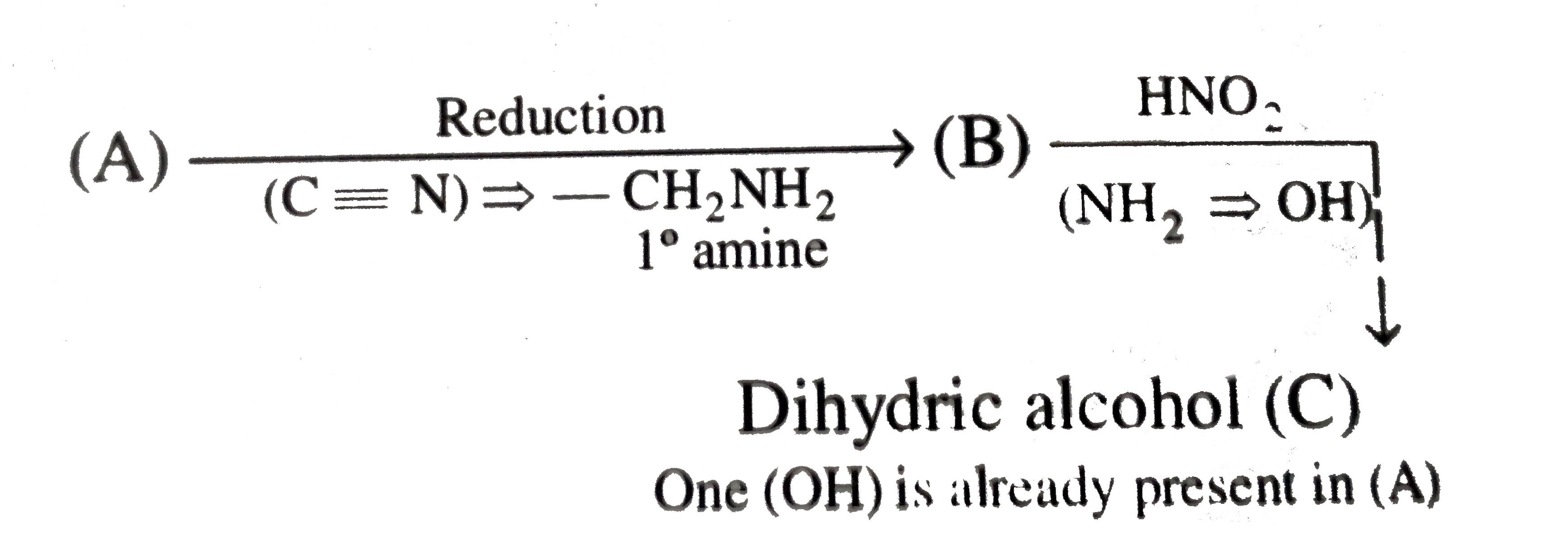 iv.So, (A) is a hydroxy compound with `(C-=N)` group and benzene. v.(A) `overset (AgNO_(3)) rarr` No ppt. It suggests BR in the benzene ring. vi.(A) `overset ([O]) rarr` 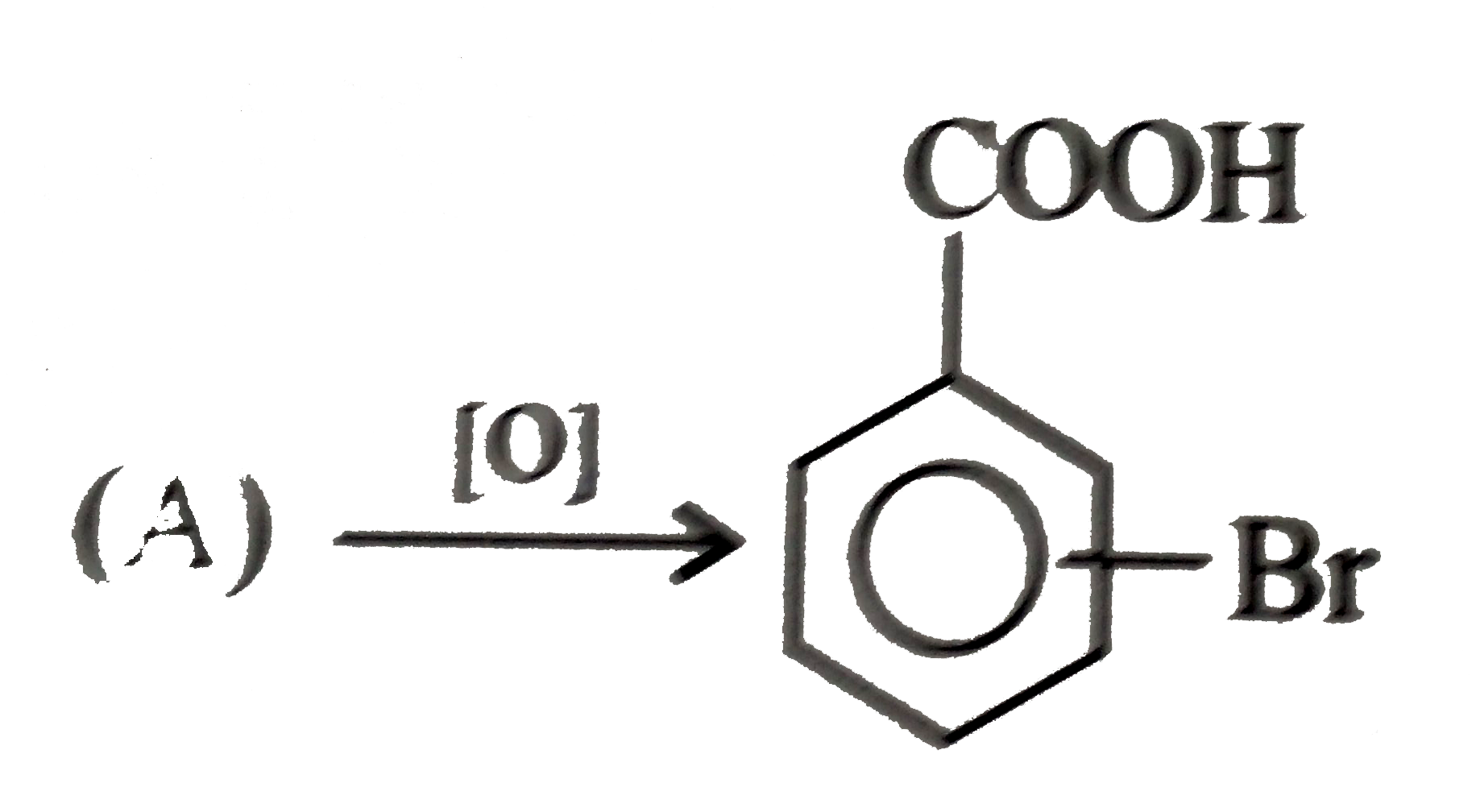 (Monobromo benzoic acid) (Br can br o-, m- or p- w.r.t. `(--COOH)` gp.) (Monobromo benzoic acid) (Br can br o-, m- or p- w.r.t. `(--COOH)` gp.) vii. `overset (Br_(2)//Fe) rarr` Gives only one PRODUCT, it suggests thatBr is present in para-position, (OMP = 231). viii. Since, (A) is chiral, so the possible structure of (A) is: 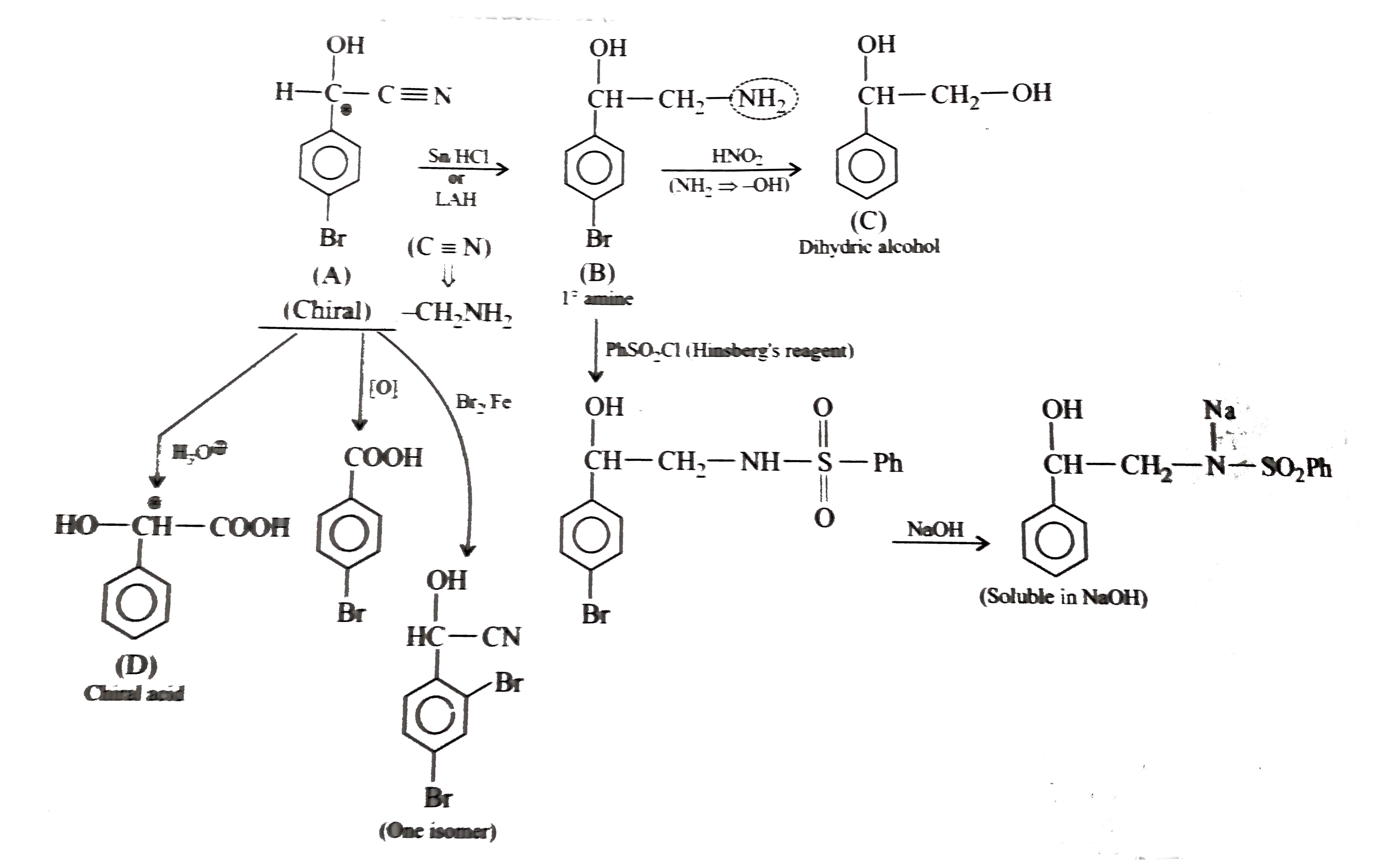
|
|