

Saved Bookmarks
| 1. |
Compound (A) on reaction with iodine in the solvent diglyme gives a hydride (B) and hydrogen gas. The product (B) is instantly hydrolysed by water or aqueous alkali forming compound ( C) and liberating hydrogen gas. The compound ( C) in aqueous solution behaves as a week mono basic acid. But in presence of certain organic polyhydroxy compound behaves as a strong monobasic acid. The hydride (B) in air catches fire spontaneously forming oxide which gives coloured beads with transition metal compounds. Which of the following statement is correct for the product (C)? |
|
Answer» It is an odd electron molecule. `B(OH)_(3)+H_(2)O to [B(OH)_(4)]^(-)+H^(+)` In the solid state, the `B(OH)_(3)` UNITS are hydrogen bonded TOGETHER in to two dimensional sheets with almost hexagonal SYMMETRY. The layered are quite a large distance apart `(3.18 A)` and thus the crystal breaks quite EASILY into very FINE particles. 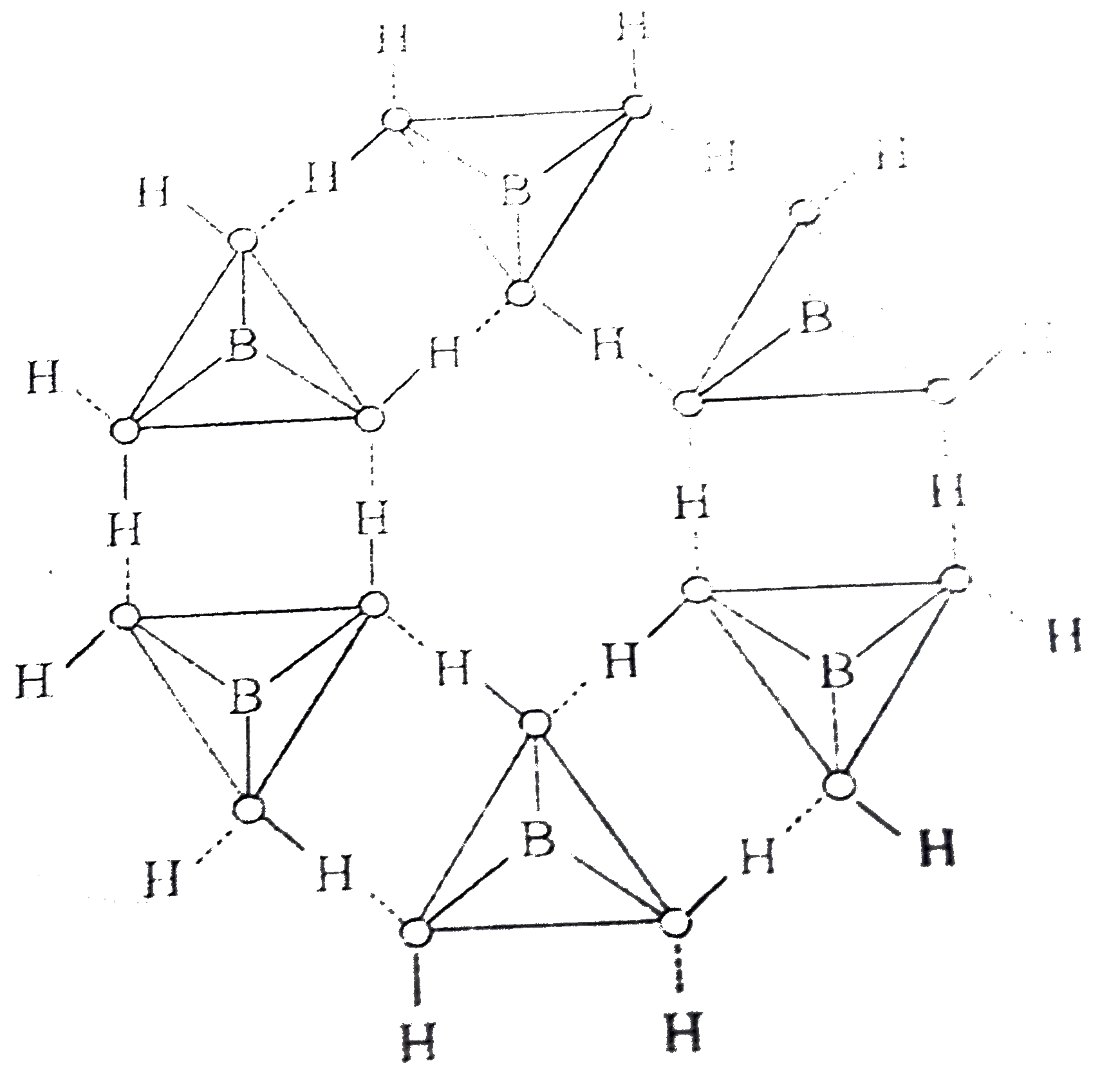 Reactions involved `(A)2Na[BH_(4)](A)+I_(2)underset("solution")overset("in diglyme")to B_(2)H_(6) , (B)+H_(2)+2NaI` `B_(2)H_(6)+6H_(2)Oto2H_(3)BO_(3)( C)+3H_(2)` `B(OH)_(3)+2H_(2)O hArrH_(3)O^(+) + [B(OH)_(4)]^(-) , pK=9.25` 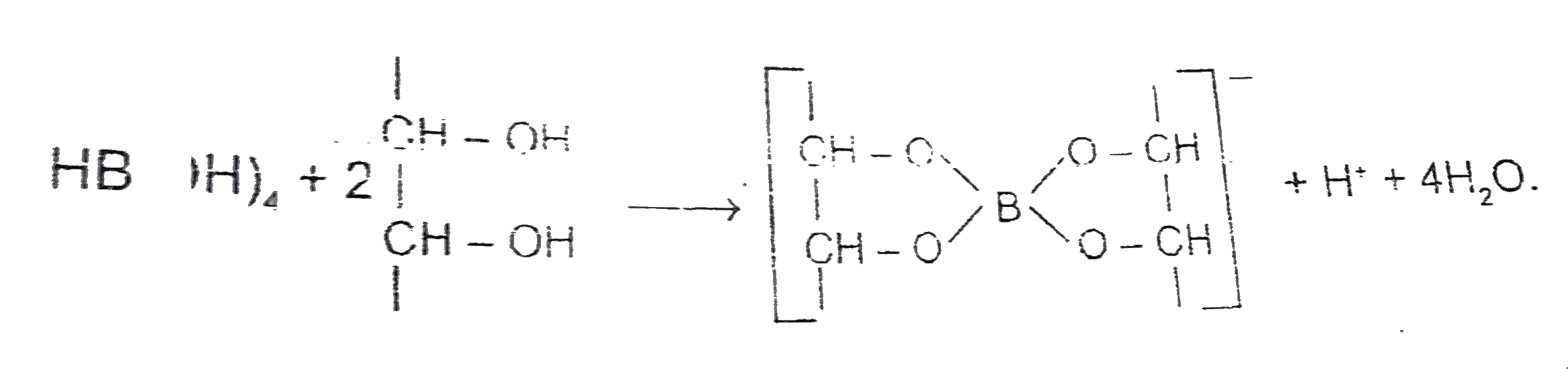 `B_(2)H_(6)(B)+3O_(2)toB_(2)O_(3)+3H_(2)O` `CoO + B_(2)O_(3)to Co(BO_(2))_(2)`(cobalt metaborate -blue colour bead). |
|