

Saved Bookmarks
| 1. |
Compound 'A' with molecular formula C_(4)H_(9)Br is treated with aq. KOH solution. The rate of this reaction depends upon the concentration of the compound 'A' only. When another optically active isomer 'B' of this compound was treated with aq. KOH solution, the rate of reaction was found to be dependent on concentration of compound and KOH both. (i) Write down the structural formula of both compounds 'A' and 'B'. (ii) Out of these two compounds, which one will be converted to the product with inverted configuration. |
|
Answer» Solution :(i) Since the rate of reaction of Compound `'A'(MF" "C_(4)H_(9)Br)`, with aq. KOH depends UPON the concentration of compound 'A" only, therefore, the reaction occurs by `S_(N)1` mechanism and the compound 'A' 2-bromo-2-methylpropane or tert-butyl bromide. `underset("2-Bromo-2-methylpropane (A)")(CH_(3)-underset(CH_(3))underset(|)overset(CH_(3))overset(|)(C)-Br)` `underset("2-Bromobutane (B)")(CH_(3)-CH_(2)-underset(Br)underset(|)overset(**)(C)H-CH_(3))` (II) Since compound 'B' is optically active and is an isomerr of compound 'A' with MF `C_(4)H_(9)Br`, therefore, compound 'B' must be 2-bromobutane. further, since the rate of reaction of compound 'B' with aq. KOH depends both upon the concentration of compound 'B' and KOH, therefore, the reaction occurs by `S_(N)2` mechanism. since in `S_(N)2` reactions, nucleophile attacks from the back sie, therefore, the PRODUCT of hydrolysis (i.e., 2-butanol) will have inverted configuration w.r.t. to 2-bromobutane. 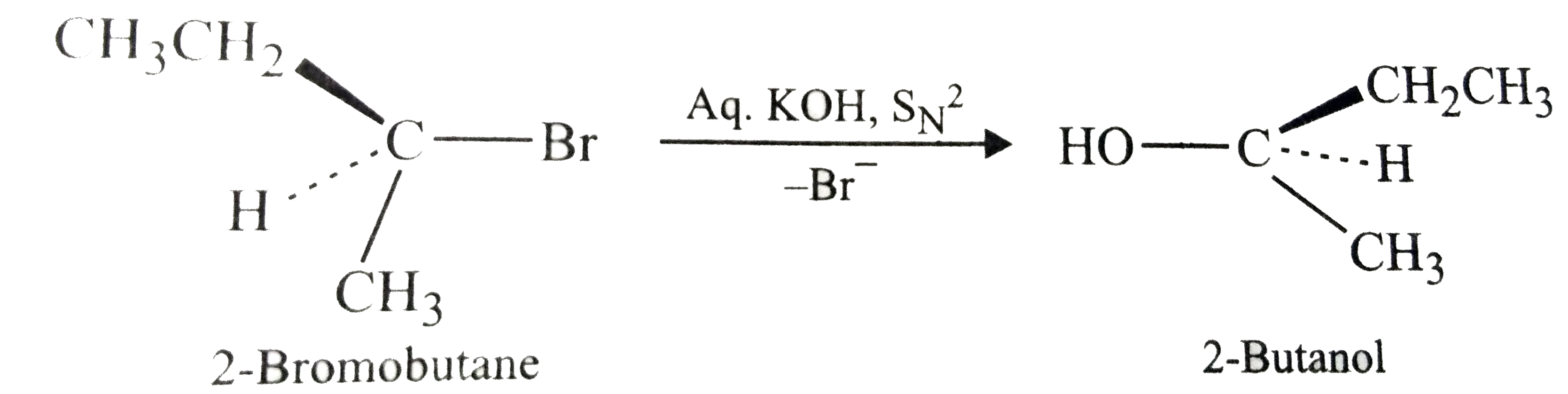
|
|