

Saved Bookmarks
| 1. |
Compound C_(8)H_(9)Cl (A) on treatmentwith KICN followedd by hydrolysis givesC_(9) H_(10) O_(2) (B). Ammoniumsalt of(B)on drydisillation yiels (C), wyhich reacts with alkene solution of bromnine to giveC_(8) H_(141) N (D). AnothercompoundC_(8) H_(10) O (E) is obtainedby the actionsby the action of nitrous acid of (D) or by the action of aqueosu potacsh on (A), (E) on oxidation gives the inner anthydide C_(8) H_(6)O_(4) (F) which gaves the inner anthdrideC_(8) H_(4) O_(3) (G) on heatingIdentify the variouscompounds (A) to (G). |
|
Answer» Solution :`D.U` in `(A) = ((2n_(C) + 2) + 2_(Cl) - n_(H))/(2)` `= ((2xx8+2)+1-9)/(2) = 5^(@)` `5 D.U` and `(C:H = 1:1)` suggest benzene ring in `(A)`, withtwo `(Me)` GROUPS or one `(Et)` group. Reaction with `KCN` shows that `(A)` contain `1^(@) RCL` group(i.e., it contains `(-CH_(2)Cl)` group in the sidechain and one `(Me)` group in the ring). Reactions: 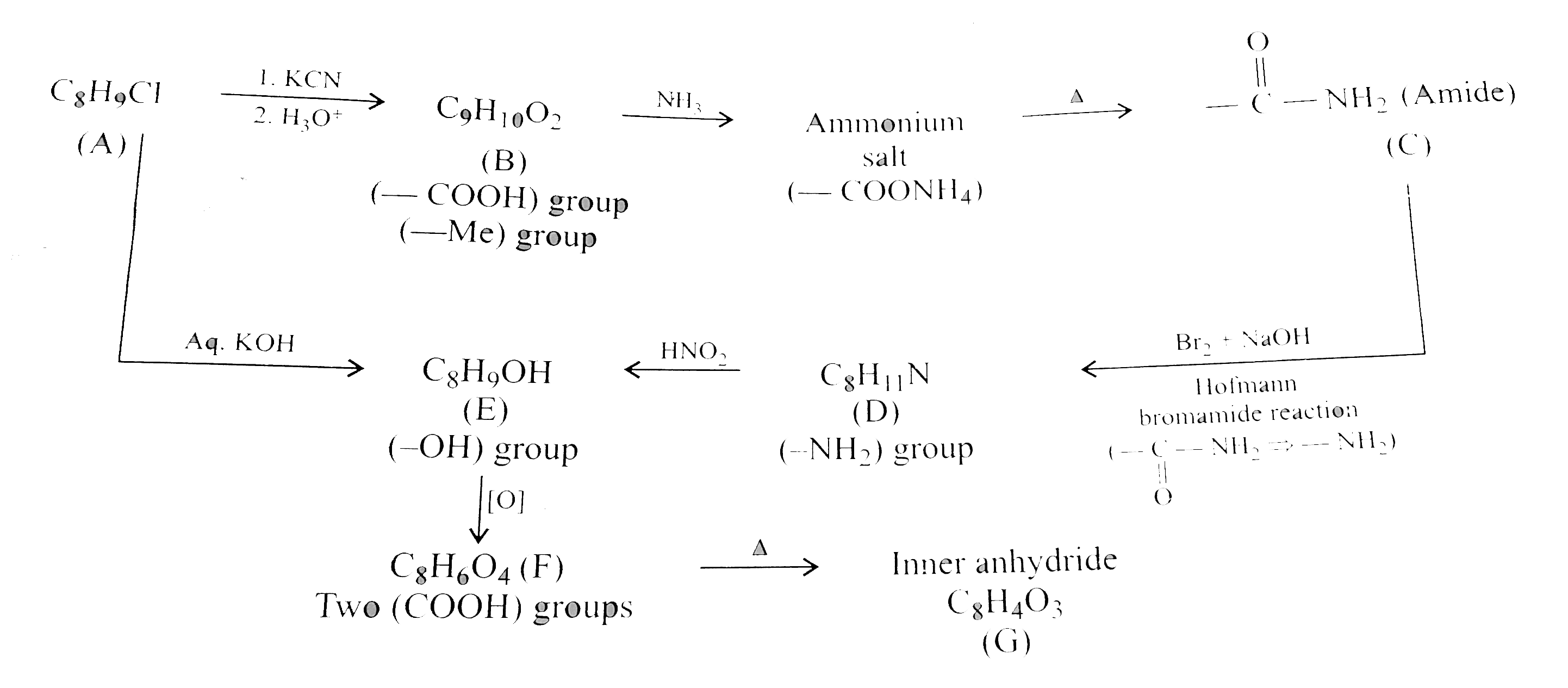 Formation of `(G)`, an anjydride shows that`(Me)` groupas is atortho-postion. orthos-diacid froms anhydride. Reactions: 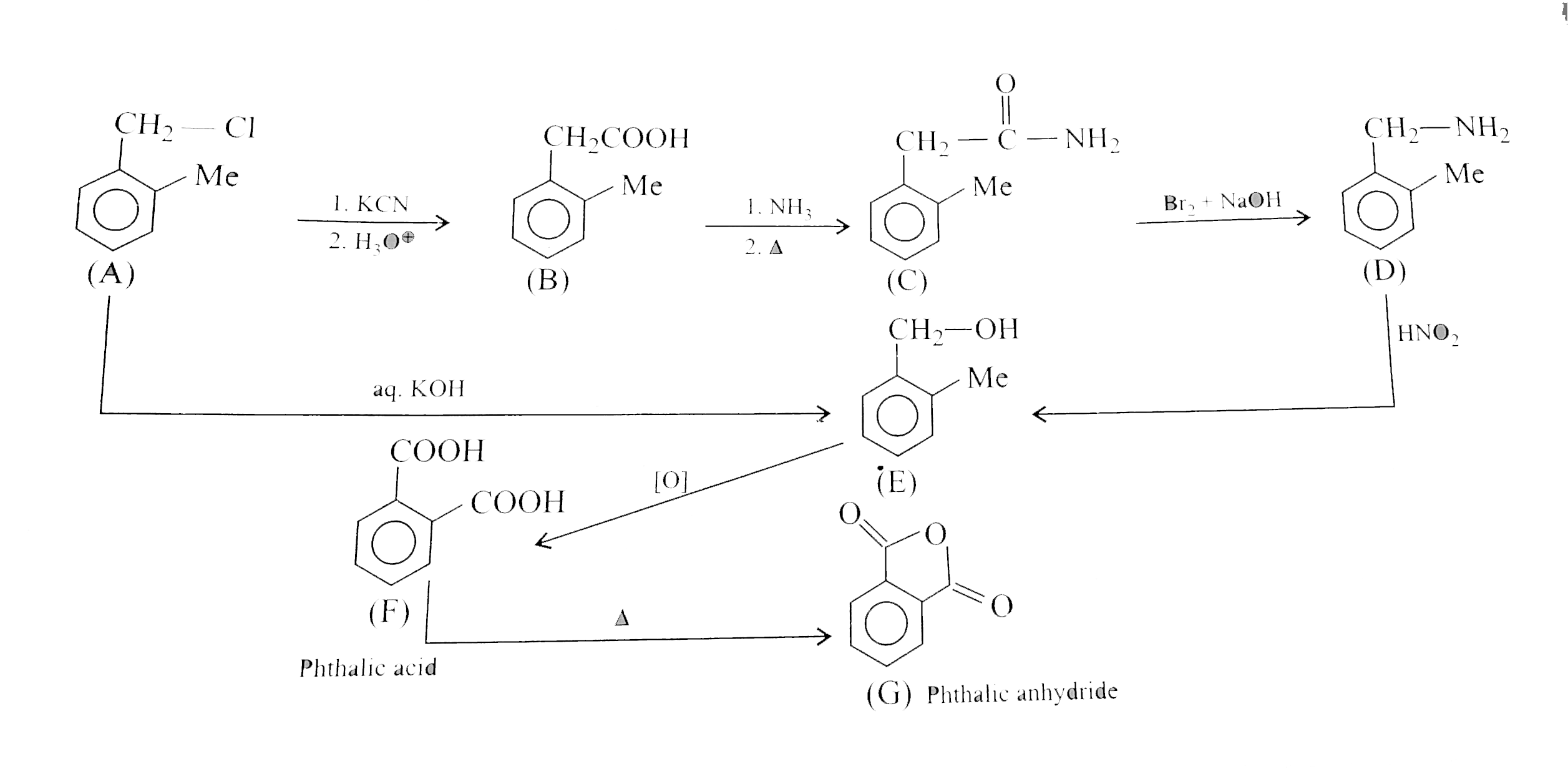
|
|