

Saved Bookmarks
| 1. |
Consider a collision between two particles one of which is at rest and the other strikes it head on with momentum P_(1). Calculate the energy of reaction Q in terms of the kinetic energy of the particles before and they collide. |
|
Answer» Solution :Initially, `m_(1)` has a momentum `P_(1)` and `m_(2)` is at rest `(P_(2) =0)` in the lab frame. The masses of the particles after the collision are `m'_(1)` and `m'_(2)` . The conservation of momentum gives `P'_(1) +P'_(2) =P'_(1)` or `P'_(2) =P'_(1) - P'_(1)` Squaring this equation , we have `P'_(1) = P_(1)^(2) + P'_(1)^(2) -2 P_(1) P'_(1)` ` =P_(1)^(2) + P'_(1)^(2) -2P_(1)P'_(1) COS theta` 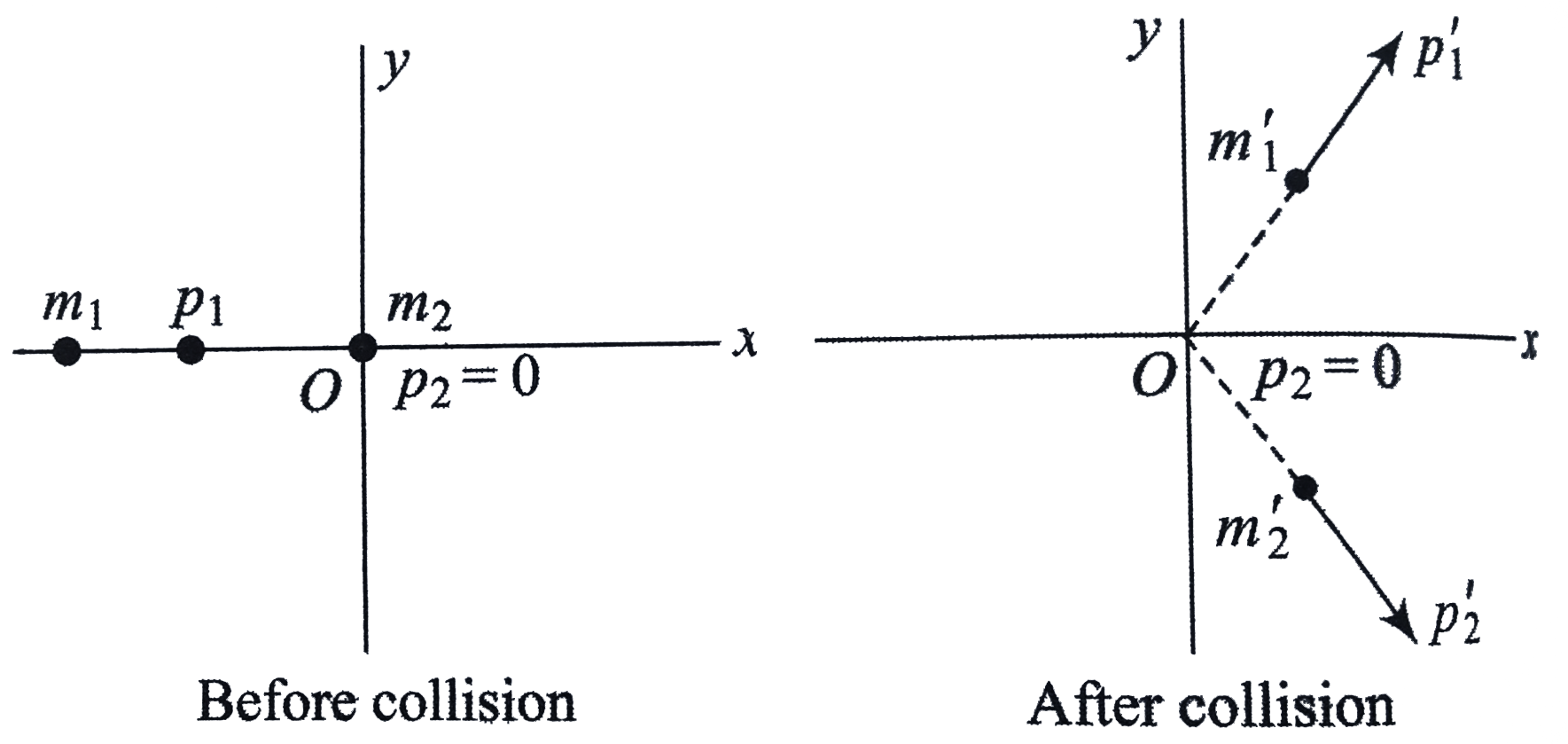 We have `Q =(P'_(1)^(2))/(2m'_(1)) +(P'_(2)^(2))/(2m'_(2)) -(P_(1)^(2))/(2) m'_(1)` `+ (1)/(2m'_(2)) (P_(1)^(2)) +P'_1^2 -2 P_(1)P'_(1) cos theta-(P_(1)^(2))/(2m_(1))` or` Q=(1)/(2) ((1)/(m_(1'))+(1)/(m_(2')))p'_(1)^(2)+(1)/(2)((1)/(m_(2'))-(1)/(m_(1)))p_(1)^(2)-(p_(1)p_(1)p)/(m_(2')) cos theta` Note that the KINETIC energy of a particle can be EXPRESSED in terms of momnetum of particles as `E_(K) =(P^(2))/(2m)` . Now, we can express the above results as `Q=D_(k,1')(1-(m_(1))/(m_(2')))=-(2(m_(1)m_(1')E_(k,1))^(1//2))/(m_(2'))cos theta ` (iii) The equation derived above is called `Q` equation . It is applied in ANALYSIS of nuclear collisions. |
|